Miele error codes: what they mean and what to do


A Miele error code tells you which system has stopped the appliance: on a dishwasher F11 is a drain fault, F24 a heating relay fault and F70 the Waterproof leak protection; on a washing machine F11 is a drain fault and F20 a heating fault; on a coffee machine F73 means the brew unit cannot return to its start position. The meanings below are taken from Miele UK’s own customer assistance pages and operating instructions, and LE Company, which repairs Miele appliances in London, adds what our engineers check. Many codes clear after the first steps Miele gives; if a code comes back, the appliance needs an engineer. For repairs, see our Miele repair page.

Miele dishwasher error codes

Older Miele dishwashers show numbered codes such as F11 and F70. Newer ones, the G 5000 range from 2019 and the G 7000 range, show most faults as words: “Drain” instead of F11, “Waterproof” instead of F70, and a general “Fault F…” for the rest. F78 is the one number those manuals still list.

What does F11 mean on a Miele dishwasher?

F11 is a drain fault: the drain pump is blocked or the non-return valve is not seated properly, and water is left in the cabinet. Miele’s first steps: unplug the machine, scoop out the water, clean the non-return valve and the drain pump, turn the pump impeller by hand, refit the filters and restart. On G 7000 and G 5000 Discovery machines built from 2019 the lower spray arm comes out first, and the part is called the drain pump cover. If F11 returns, call an engineer.

Miele dishwasher F24

F24 is a fault in the heating relay contact. There is nothing for the user to do: Miele says to book a repair.

Miele dishwasher F70: the Waterproof system

F70 means the Waterproof leak protection has tripped: the programme stops and the drain pump runs. Miele says to close the stopcock, switch the machine off and unplug it, then call service. Leaks are the subject of our Miele dishwasher leaks guide.

Miele dishwasher F14, F78 and F79

F78 is a blocked circulation pump, usually one that has dried out after a long break or at first use. F14 can be the same stuck pump, or a fault in the water intake or the pressure and heating level switches. For a stuck pump, Miele advises pouring 1 litre of warm water (no hotter than 75 °C) with 3–5 drops of rinse aid into the cabinet, waiting 5 minutes and restarting, two or three times. F79 is a circulation pump fault and needs a repair.
Not every dishwasher fault shows a code. In October 2026 we attended a Miele G 6260 whose door lock had broken: a piece of the lock had snapped off inside the door, and both the door lock and the door opener had to be replaced. See our Miele dishwasher repair page.

Miele washing machine error codes

F11: drain restricted. The drain hose end is more than 1 m high or kinked, or the drain filter or pump is blocked. Straighten the hose, drain the water slowly through the drain filter (it can be hot), clean the filter and check the pump impeller turns.
F20 or “Heating fault”: either Thermostop, where the programme simply pauses until the water reaches temperature, or a heating fault. Disconnect from the mains for at least 2 minutes and restart; if it persists, call an engineer.
F10, “Water inlet fault” or the Check inlet light: water is not coming in. Open the stopcock, clean the inlet filter and straighten the hose. Miele’s test for pressure: a fully open stopcock should give at least 5 litres in 15 seconds.
F1: a short circuit in the water temperature sensor circuit; it needs a repair. Do not confuse it with the “i” light and a “1” in the display, which is not a fault: it is a reminder that no wash above 60 °C has been run for a long time. Run Cottons at 90 °C with a machine cleaner or powder detergent.
F220: the machine is leaking. Miele notes it can also appear by mistake: disconnect, check for water, and if there is none, reconnect and run a programme.

Miele oven error codes: F44, F10 and F235

Oven F44: a technical fault. Miele says to switch the power off at the circuit breaker for 20 seconds; if F44 comes back, call an engineer.
Steam oven F10: a water inlet fault. The feed pump may have dried out after a long time unused, the suction hose in the water container may be missing or badly fitted, or, with a reverse osmosis system, the water may be too pure for the oven to detect. Steam oven F235: an electronic module fault, which needs a repair. Read why Miele ovens are built to last.

Miele tumble dryer error codes: F2 and F66

F66 (often searched as 066) is mostly dirty fluff filters or a dirty plinth filter. It can also be an overloaded drum, a blocked ventilation grille under the door or a poorly ventilated room. Clean the fluff and plinth filters, vacuum the heat exchanger gently and reduce the load. F2 is an open circuit at the refrigerant temperature sensor and needs a repair. See how to diagnose common Miele dryer issues.

Miele coffee machine error codes

F10: no water is being drawn in. Fill the water container three-quarters full, insert and remove it 10–20 times, then descale. F17: on a built-in machine, mains water is not reaching it (valve closed, hose kinked or the float in the water container stuck); on a countertop machine, very little water is being drawn in. F73: the brew unit cannot return to its start position or is dirty; rinse it without detergent and try less coffee or a finer grind. F74: a fault in valve adjustment; switch off and on, then descale. F77: a valve initialisation error; disconnect from the mains and reconnect. See our Miele coffee machine repair page.

When to call an engineer

Call an engineer when a code comes back after Miele’s first steps, or straight away for codes Miele says need a repair: dishwasher F24, F70 and F79, washing machine F1, steam oven F235 and dryer F2. Every repair we do starts with checking and cleaning the appliance. Many of the codes above, from F11 to F66 and F74, come from filters, pumps and valves that have not been cleaned or descaled, and after a service the appliance often works again. Comparing brands? Read Gaggenau vs Miele.

Book a Miele repair in London

LE Company’s call-out is from £175 + VAT and includes the first 30 minutes on site, when the engineer finds the cause of the fault. The cost of the repair is agreed with you before any work starts. Call +44 203 603 7172, or see our frequently asked questions.
Lacanche vs AGA: an engineer’s comparison


A Lacanche is a modern premium range cooker; an AGA is a cooker for enthusiasts. LE Company engineers repair both in London, and from what we see: the classic AGA was designed many years ago to heat the house as well as to cook, it is very heavy, and its ovens are small. Even the modern AGA made only for cooking has nothing exclusive that would make us tell you to buy one. People who choose an AGA usually want an AGA, often because their parents had one. If you simply want a premium cooker, choose the Lacanche. For repairs, see our Lacanche repair and AGA repair pages.

What is the difference between an AGA and a range cooker?

An AGA is not built like an ordinary range cooker. It is made of iron and very well insulated, and the heat it builds up stays inside it. Its main purpose was not only to cook but to heat the home, which is why the classic AGA always has two hot plates on top that are always hot. The first AGA was invented in 1922 by the Swedish physicist Gustaf Dalén. AGA itself says its older cookers were fully on around the clock, while on today’s models individual ovens and hotplates can be switched on and off as needed.
A range cooker such as a Lacanche heats only when you turn it on. On the Lacanche ranges we usually work on, the left oven is gas, the right oven is electric, and the burners on the hob are gas.

Lacanche vs AGA: ovens and cooking

The ovens of an AGA are mostly very small, so there is little space to cook in. In return, the iron body and good insulation hold the temperature constantly. The ovens of a Lacanche heat up when you need them and switch off when you finish, and its hob has a gas flame that lights instantly and is very beautiful.
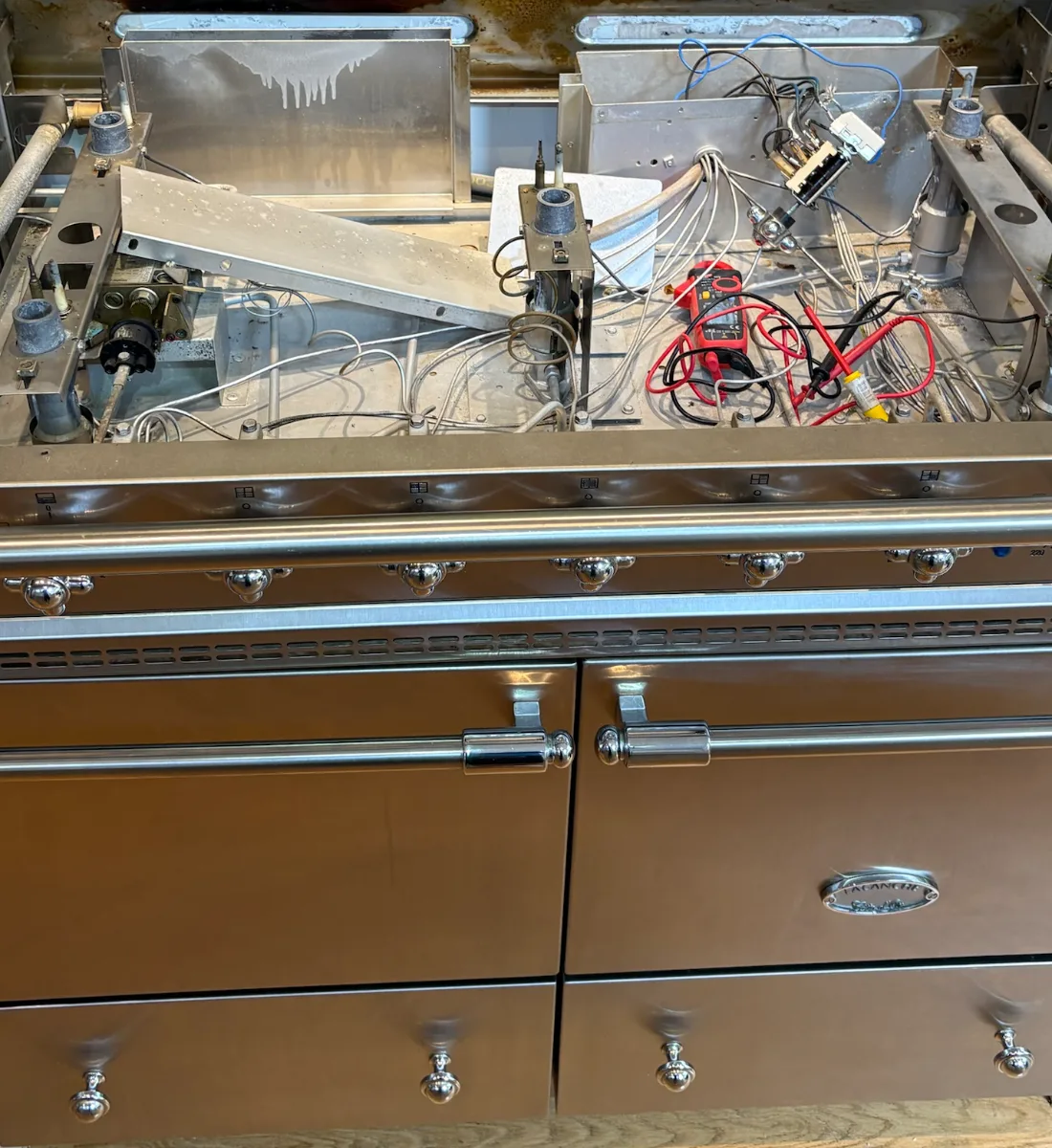
Lacanche range cooker with the hob top lifted to reach the oven controls and wiring

Is an AGA worth it?

Only if you want an AGA for its own sake. As engineers, we find nothing special or exclusive in it that would let us say: yes, buy it. Keep the summer in mind too. An AGA holds heat all the time, and if you cook on it in summer, that heat goes into your kitchen and has to go somewhere.

Is a Lacanche worth it?

Yes, if you want a premium range that rarely breaks. There is almost no electronics in a Lacanche: the controls are simple switches and thermostats, which is why our Lacanche oven not heating case came down to one burnt switch. Its oven is painted metal, easy to wipe clean, and its doors are light enough for an engineer to lift off, which keeps servicing simple. For a Lacanche against the other French range, see our Lacanche vs La Cornue comparison, and how to clean your Lacanche oven.

Lacanche or AGA: which should you buy?

Choose a Lacanche if you want a modern premium cooker: gas burners, a gas and an electric oven, simple controls and few repairs. Choose an AGA if you want an AGA: a heavy iron cooker that keeps its heat, warms the kitchen and has two hot plates always ready, and you accept small ovens and a warm kitchen in summer. Whichever you have, regular servicing keeps it going, as in our AGA oven servicing job.

Book a Lacanche or AGA repair in London

LE Company’s call-out is from £175 + VAT and includes the first 30 minutes on site, when the engineer finds the cause of the fault. The cost of the repair is agreed with you before any work starts. Our engineers are Gas Safe registered. Call +44 203 603 7172, or see our frequently asked questions.

Liebherr vs Gaggenau fridge: an engineer’s comparison


If you cannot decide between a Liebherr and a Gaggenau fridge, buy the brand you like more. LE Company engineers repair both in London, and most of the Liebherr fridges we work on use the same control boards and the same design as Gaggenau. The differences we see are in the spare parts and in the repair itself: Liebherr parts arrive a little faster, and on the Liebherr models that have no Gaggenau twin, the fridge is quicker to take apart and put back together. For repairs, see our Liebherr appliance repair and Gaggenau fridge repair pages.

Liebherr vs Gaggenau fridge: what is the difference?

Less than the price lists suggest. Most Liebherr fridges we repair use the same control boards, the electronics that run the fridge, and the same design as the Gaggenau fridges we repair. Because we work on all of these models, we know which parts fit both brands.
Some models are not shared and exist only under one brand. On those, we would put Liebherr ahead for the repair engineer: the fridge is designed so that taking it apart and putting it back together takes less time than on a Gaggenau. Less time on site means a shorter repair.

Spare parts: Liebherr or Gaggenau, which arrive faster?

Liebherr parts reach us a little faster than Gaggenau parts. Some Gaggenau parts can be out of stock, and then we get the same part from Liebherr. If one brand does not have a part, we ask the other. Knowing which parts are interchangeable is what lets us find a part in a shorter time than waiting for one brand alone.
This matters because “available” is not always true. In October we met a Gaggenau wine fridge whose control board had already been discontinued. See also our wine fridge repair page.

Are Liebherr fridges any good?

Yes. In our experience a Liebherr is a fridge of the same class as a Gaggenau, and easier to service on the models that are its own. As with any brand, look at how it is cooled: whether the air is driven through the evaporator, or only a back panel is cold. A fridge with a cold back panel suits four or five door openings a day. We explain this in are expensive fridges worth it.

Where Gaggenau is ahead

For design, we put Gaggenau first among the premium fridges we work on. Its weak point is the condenser, which has to be cleaned: when it is covered in dust the fridge overheats and the heat damages the electronics. That is what we found in a Gaggenau freezer that was alarming and not freezing. For Gaggenau against Miele, see our Gaggenau vs Miele comparison.
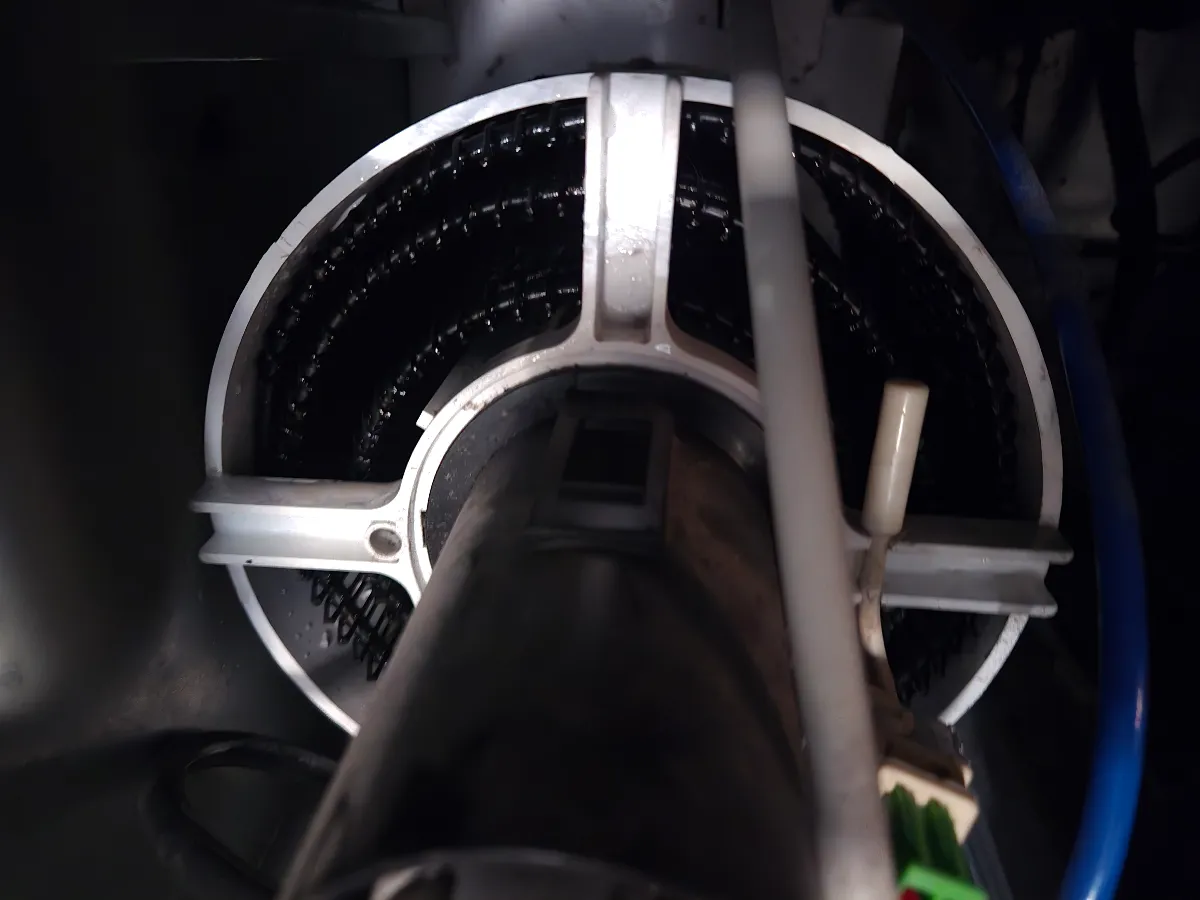
Gaggenau freezer condenser after cleaning by LE Company

Who makes Liebherr and Gaggenau?

Liebherr is a family-owned company. It has made fridges and freezers in Ochsenhausen, Germany, since 1954, and also makes them in Lienz, Austria, and in Bulgaria, India and Malaysia. Gaggenau has been part of BSH, the Bosch home appliance group, since 1995.

Warranty in the UK

Liebherr gives a two-year manufacturer’s guarantee in the UK. Its paid WarrantyPlus adds 3 or 8 years, for 5 or 10 years in total, and lists spare parts availability of up to 10 years. Gaggenau’s UK terms extend its 2-year warranty by a further 3 years, to 5 in total, and Gaggenau says parts are available for up to 15 years after a model goes out of production. Check the conditions with each brand when you register the appliance.

Liebherr or Gaggenau: which should you buy?

If you are in doubt, take the brand you like more. Inside, most models are close relatives, and we can find parts for both. If design matters most, Gaggenau. If you want the quicker repair on a model of its own, Liebherr. Whichever you choose, have the condenser checked by an engineer a year after it was cleaned, as we describe in how often to clean fridge condenser coils.

Book a Liebherr or Gaggenau fridge repair in London

LE Company’s call-out is from £175 + VAT and includes the first 30 minutes on site, when the engineer finds the cause of the fault. The cost of the repair is agreed with you before any work starts. Call +44 203 603 7172, or see our fridge repair service in London and frequently asked questions.

Gaggenau vs Miele: an engineer’s comparison


Gaggenau and Miele are both premium German brands, and both make a top line and a lower line. LE Company engineers repair both in London, and from what we see inside them: if you plan to spend between £1,000 and £2,000 on an appliance, at 2025–2026 prices, there is no real difference between the two. In premium fridges Gaggenau is ahead: it moves cold air better and uses less energy. In dishwashers the washing quality is practically the same. In ovens both are at the top, but recently SMEG has overtaken them. For repairs, see our Gaggenau repair and Miele repair pages.

Gaggenau vs Miele fridge

With both brands, look at how the fridge is cooled, not at the badge. If you buy a fridge where only the back panel is cooled and a fan stirs the air, do not expect a good flow of cold air inside. You can open it four or five times a day. Open it more often and the air temperature rises, on average to around 9–11°C. The food already inside is not harmed, because it holds its own temperature. But new food you put in will only be properly cold the next morning, and you will not get that feeling of cold air meeting you when you open the door. That you only get with top-class fridges. We explain the difference in detail in are expensive fridges worth it.
In the premium models, Gaggenau is ahead. Its whole system is built to move the air: the air is driven through the cooling panels, through the evaporator inside them, and back into the compartment. For low energy use we would also put Gaggenau first. Its one weak point is a condenser that needs cleaning, as in this Gaggenau freezer that was alarming and not freezing. See our Gaggenau fridge repair page, and our Liebherr vs Gaggenau fridge comparison.
Gaggenau freezer condenser after cleaning by LE Company

Gaggenau vs Miele oven, and why SMEG has overtaken both

In ovens, both Gaggenau and Miele hold top positions. Recently, though, SMEG has overtaken them. Its Galileo Omnichef combines three ovens in one: a microwave, a steam oven and a conventional oven.
Its handling of water is excellent. There is practically no water left in the system: when you finish cooking, the oven makes you empty it. That is why you will practically never get a leak. We tested it hard for five years, expecting something to break. In all that time we replaced only one conventional heating element, and that happens on every make of oven.
SMEG’s build quality is very high, and we would put it at the very top. Every joint is fitted with a gasket, which we do not see on any other make. You will practically never hear a rattle, a vibration or a scrape, and opening and closing the door is a pleasure in itself. Even the smaller, compact model has an inside that looks practically no different from a full-size Gaggenau or Miele. See why a Smeg oven stops working, our SMEG oven repair and Gaggenau oven repair pages, and why Miele ovens are built to last.

Gaggenau vs Miele dishwasher

Here the quality is the same, and the leak protection is the same. Washing quality is practically identical. Choose by what you like: in the new models, look at the functions and how convenient they are to use. If your Miele shows a code, see Miele error codes. See our Miele dishwasher repair page and what to do when a Gaggenau dishwasher is not draining.

Who makes Gaggenau and Miele?

Miele is a family-owned company, owned by the Miele and Zinkann families. Its ovens are made in Oelde, its steam ovens and hobs in Bünde and its dishwashers in Bielefeld, all in Germany. Gaggenau has been part of BSH, the Bosch home appliance group, since 1995. It names factories in Germany, France, Slovenia, Spain and Turkey; the built-in Gaggenau fridge we repaired in November was labelled made in Turkey.

Warranty and spare parts

Miele gives a standard 2-year manufacturer’s guarantee on its domestic appliances in the UK, with longer cover in promotions or as a paid extension. Gaggenau’s UK terms extend its 2-year warranty by a further 3 years, to 5 in total; check the conditions when you register the appliance. Both brands say spare parts are available for up to 15 years after a model goes out of production. “Up to” matters: in October we met a Gaggenau wine fridge whose control board had already been discontinued.

Is Miele really tested for 20 years?

Miele tests some appliances to simulate 20 years of average household use, for example 5,600 cycles for dishwashers and 2,160 hours for ovens and steam ovens. Miele itself says this is not a guarantee of durability, and its list does not include fridges, coffee machines or hobs.

Gaggenau or Miele: which should you buy?

For a fridge in the £1,000–2,000 range, either; check how it is cooled. For a premium fridge, Gaggenau, for the air flow and the low energy use. For a dishwasher, whichever functions you like. For an oven, look at SMEG as well as Gaggenau and Miele. If you are comparing range cookers, see our Lacanche vs La Cornue comparison.

Book a Gaggenau or Miele repair in London

LE Company’s call-out is from £175 + VAT and includes the first 30 minutes on site, when the engineer finds the cause of the fault. The cost of the repair is agreed with you before any work starts. Call +44 203 603 7172, or see our frequently asked questions.
Are expensive fridges worth it? Cheap vs expensive fridge, from an engineer


An expensive fridge is worth it if your fridge door is opened many times a day. LE Company engineers repair premium refrigerators such as Sub-Zero and Gaggenau in London every week, and from what we see inside them, the real difference between a cheap and an expensive fridge comes down to two things: how fast the air inside gets cold again after you open the door, and whether the fridge and the freezer each have their own compressor. Everything else, including the temperature on the display, tells you much less. For repairs, see our Sub-Zero repair and Gaggenau fridge repair pages.

Cheap vs expensive fridge: how many times can you open the door?

This is the main difference. In a top fridge, such as a Sub-Zero or a Gaggenau, you open the door, close it, and the air inside is cold again almost at once. You can open the door as often as you like. A low-priced fridge is designed around opening the door only about five times a day. Open it more than that and it may only get back to its proper temperature overnight.
The temperature on the display usually does not show this. Manufacturers do not want to worry you, so the screen keeps showing the set temperature while the air inside is still warming up and cooling down again.

How the cold gets inside: cold plate or air through the evaporator

Fridges fall into two types. In the simpler type the cold comes from a cold plate on the back wall of the fridge. Some of these have a fan that moves the air around, but the air does not pass through the evaporator, the part that actually takes the heat out. In the better type the air is driven through the evaporator and back into the compartment, which is what lets it get cold again so quickly.
A fridge that relies only on the cold back panel is also much more likely to collect excess moisture at the bottom. That is a nuisance, but it is not the main point: the main point is how many times a day you can open the door.

Dual compressor fridge: one compressor for the fridge, one for the freezer

The second big difference is the number of compressors, the motors that drive the cooling. Top fridges always have a separate compressor for the freezer and another for the fridge. When you choose a fridge freezer, this is the other thing to check, along with how the air moves inside.

Sub-Zero vs Gaggenau fridge

Among the expensive fridges we work on, Sub-Zero and Gaggenau are the two we would put at the top. For design, we would put Gaggenau first. Compared with a Sub-Zero moving the same amount of air inside, a Gaggenau uses less energy.
The Gaggenau built-in fridge is not only a Gaggenau. Gaggenau belongs to BSH, the Bosch home appliance group, and its fridges share their design with the American brand Thermador, also part of BSH. The service and test manuals that experienced engineers work from carry the Thermador name, and we have met the same fridge sold under other names as well. In Europe it is sold as Gaggenau. For Gaggenau against Miele, see our Gaggenau vs Miele comparison, and for Liebherr, our Liebherr vs Gaggenau fridge comparison.

What goes wrong with a Gaggenau fridge?

It has one real problem, and it appears in almost every report we write on these fridges: the condenser has to be cleaned. The condenser carries the heat out of the fridge. When it is covered in dust the machine overheats, and the heat damages the electronics. That is exactly what we found in a Gaggenau freezer that was alarming and not freezing.
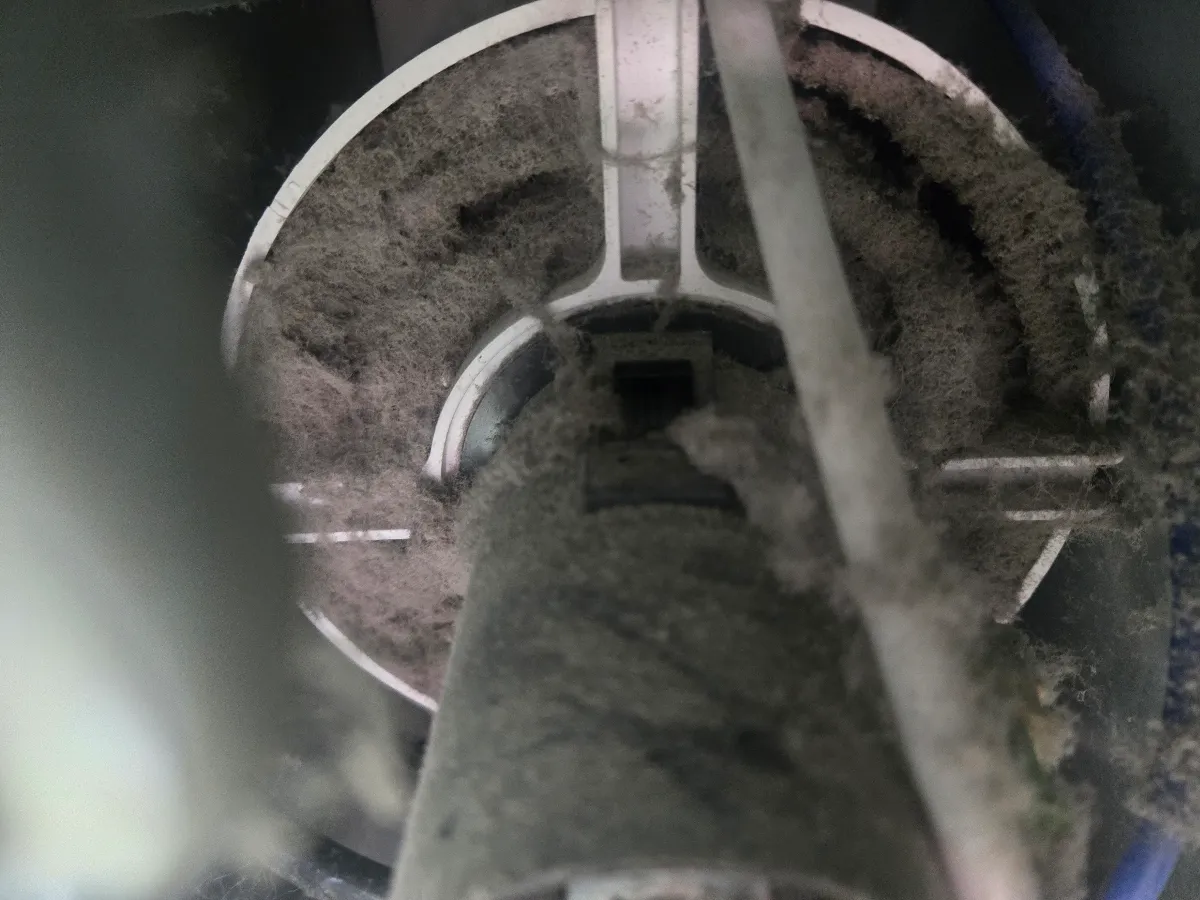
Gaggenau freezer condenser and fan clogged with dust
Apart from that, the faults are mechanical, or something goes wrong with the water supply. The compressor itself fails from overheating. If it has not been allowed to overheat and the fridge has been serviced, you can expect the compressor to run for about 15 years. More often it is the compressor's control board that fails first, the part we call the inverter.

How often to clean fridge condenser coils

Usually we say once every six years. But if you keep doors to the outside open at home, or you have pets, it can be once a year. The right interval is found by experience: have an engineer look at the condenser a year after it was cleaned. If nothing has built up, the engineer will tell you when the next check is due. See also our Sub-Zero maintenance service.
Gaggenau freezer condenser after cleaning by LE Company

Which fridge should you buy?

Whatever the price, check two things. First, how the cold reaches the food: air driven through the evaporator, or only a cold back panel. Second, whether the freezer and the fridge each have their own compressor. If your family opens the fridge many times a day, a fridge that does both is worth paying for. If it is opened a few times a day, a cheaper fridge will do the job.
If you already own a Sub-Zero, read whether a Sub-Zero is worth repairing and what its error codes mean.

Book a fridge repair or condenser clean in London

LE Company’s call-out is from £175 + VAT and includes the first 30 minutes on site, when the engineer finds the cause of the fault. The cost of the repair is agreed with you before any work starts. Call +44 203 603 7172, or see our fridge repair service in London and frequently asked questions.

Lacanche vs La Cornue: an engineer’s comparison


Lacanche and La Cornue are the two French range cookers our customers ask us about most. LE Company engineers have been repairing and servicing both in London for about ten years, so this comparison is not about brochures: it is about what breaks, what it costs to fix and what each cooker is like to live with. In short, La Cornue is the more heavily built and more expensive range, and you should expect much bigger repair bills; Lacanche is the more affordable of the two and costs far less to keep running. For repairs, see our Lacanche repair and La Cornue repair pages.

Lacanche vs La Cornue: price to buy and price to repair

La Cornue costs much more than Lacanche, both when you buy it and every time a part is needed. Before you buy one, it is worth knowing that if something breaks, the repair will cost a lot, and often very much more than on a Lacanche.
One example: the igniter for the gas section of a La Cornue used to cost about £350 and today costs more than £1,000.

Which is better built?

La Cornue. You feel it the moment you work on one. The metal is thicker, the insulation inside is better, and the oven holds a set temperature more steadily than a Lacanche. The doors are so heavy that it takes two hands, and some effort, to take one off.
A Lacanche is lighter. An engineer can lift a door off, stand it in the corner and start work. That lightness is part of why it is cheaper to service.
Lacanche range cooker with the hob top lifted to reach the oven controls and wiring

Which breaks down more often?

Lacanche, much less often. There is almost no electronics in a Lacanche: the controls are simple switches and thermostats, which is why our Lacanche oven not heating case came down to one burnt switch. A La Cornue is packed with electronics, and more parts means more that can fail.
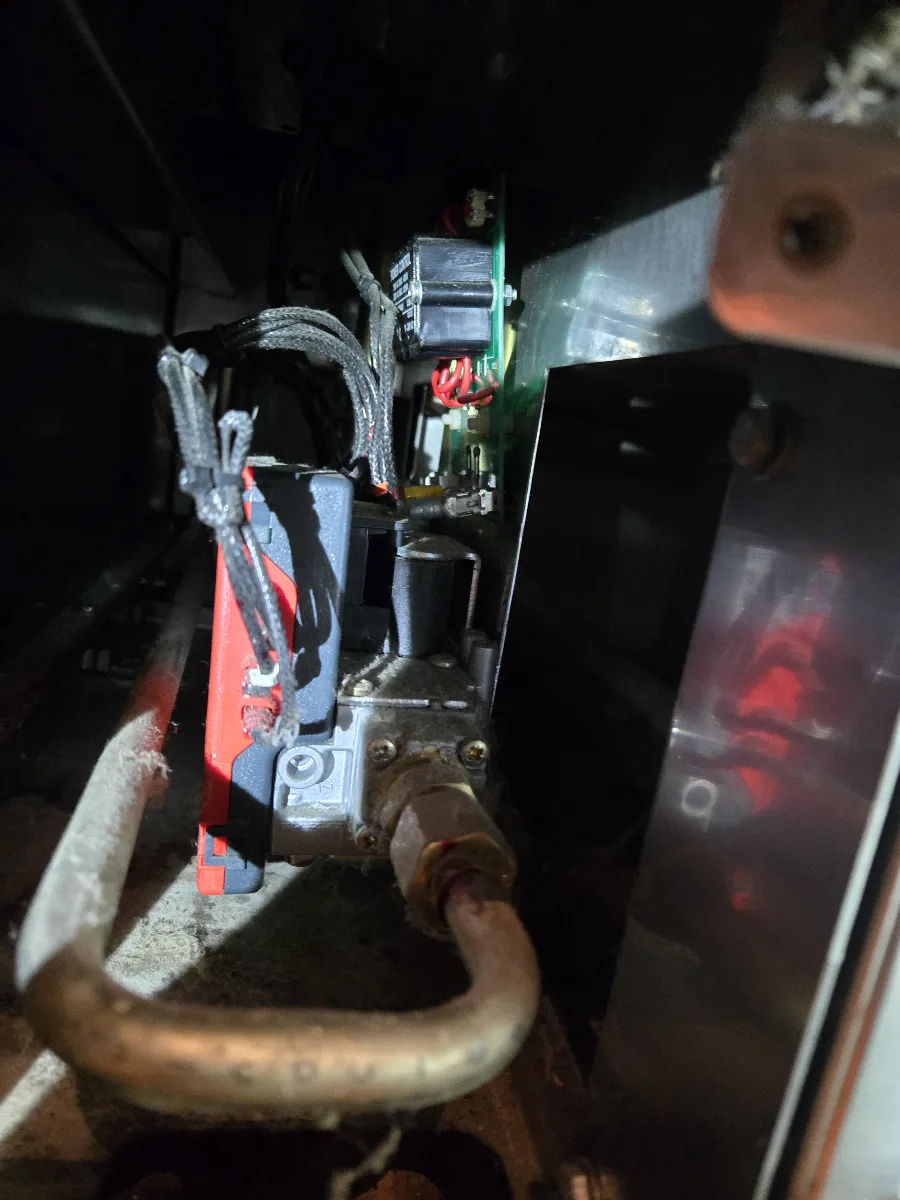
La Cornue gas oven valve with the ignition wiring and control board behind it
In November we attended a La Cornue whose gas oven kept switching off. The igniter was heating but no longer reaching the temperature needed to light the burner, its wiring and fixings had rusted, and the bolts had to be drilled out. The igniter system and glow element both had to be replaced.

The La Cornue gas valve problem

Older La Cornue ranges, the really old ones, have very good gas valves. Modern models have a weakness. The heavy decorative brass knobs are fitted to aluminium gas valves. Over the years the valve wears, the weight of the knob starts to turn it down by itself, and the flame drops or goes out on its own. The only repair is a new valve, and it is an expensive one.
A Lacanche does not have this problem. Its knobs are light and not weighted to one side, so the cooker works the same way for its whole life.

Looks, burners and cleaning

On looks, La Cornue wins: it looks more expensive and more striking, with a lot of copper trim. Kept polished, the copper shines like gold. The burners are another matter: over time they gradually bend from the heat and end up looking terrible, and replacing each one costs around £300.
Inside the ovens the two are built differently. A La Cornue oven is lined with aluminium, which is practically impossible to clean. A Lacanche oven is painted metal: it is thinner and less insulated, so it does not hold heat as well, but it is easy to wipe clean.

Where they are the same: door hinges

On both ranges the most common problem is the oven door hinges. Here the two makes meet: replacing or repairing the hinges costs about the same on a Lacanche as on a La Cornue.

How long do they last?

With proper care, there is practically no limit to the service life of either cooker. Hinges, igniters, switches and thermostats wear out and are replaced, and the range carries on. Keeping it clean matters: see how to clean your Lacanche oven and how to look after your La Cornue.

Lacanche or La Cornue: which should you buy?

Choose a Lacanche if you want a beautiful French range that will practically never take your money. It looks good, lights instantly, and its flame is very beautiful, even more so than on a La Cornue. It is the more affordable of the two to buy and by far the cheaper to keep running.
Choose a La Cornue if you want the heavier build, the thicker metal and the steadier oven temperature, and you are ready for large repair bills when something does break.
If you are comparing other range cookers, we also repair AGA, Rangemaster and Wolf. See also Gaggenau vs Miele and Lacanche vs AGA.

Book a Lacanche or La Cornue repair in London

LE Company’s call-out is from £175 + VAT and includes the first 30 minutes on site, when the engineer finds the cause of the fault. The cost of the repair is agreed with you before any work starts. Our engineers are Gas Safe registered. Call +44 203 603 7172, or see our frequently asked questions for prices and parts.

Lacanche oven not heating: a burnt selector switch


When a Lacanche oven stops heating completely, the cause can be a single burnt switch rather than the elements or the thermostat. That is what LE Company engineers found this autumn in a home in South London, on a Lacanche double-oven range cooker whose electric oven side had stopped working. One switch was broken; the owner chose to renew the whole oven control set, and the cooker is working again. Here is what we found and why. For our full Lacanche service, see Lacanche repair in London.

Why is my Lacanche oven not heating?

On arrival the oven was not working at all: no electrical supply was reaching it. On a Lacanche the usual cause of this symptom is the high limit switch, the safety cut-out that disconnects the oven if it overheats, so that was our first suspect. We lifted the hob top to reach the oven controls and wiring.
Lacanche range cooker with the hob top lifted to reach the oven controls and wiring

What we found: a burnt oven selector switch

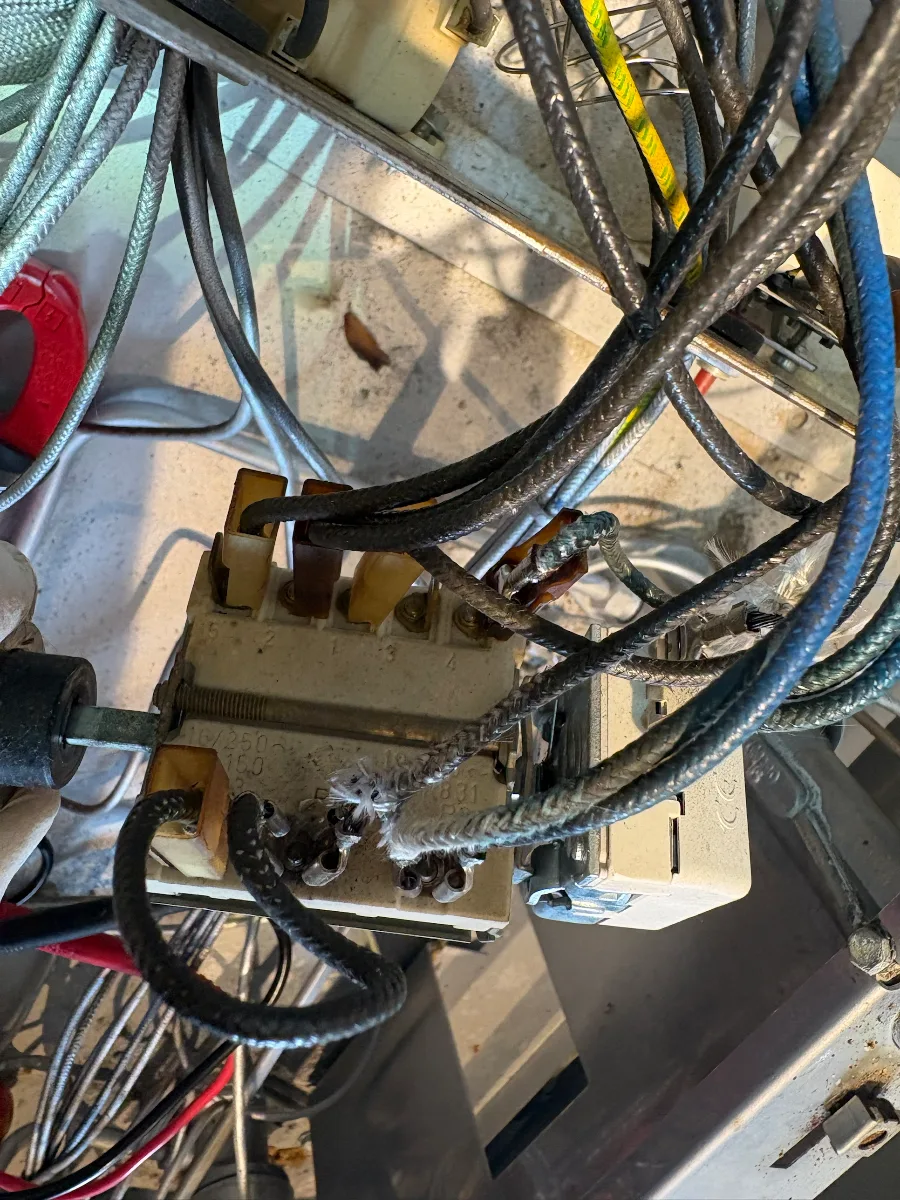
The fault was not the high limit switch. The oven selector (function) switch, the knob that chooses the oven mode, had burnt: its terminals and the ends of the wires connected to it were charred and heat-damaged. All the power for the oven passes through this switch, so when its contacts fail the oven gets nothing.
Burnt terminals and heat-damaged wire ends on a Lacanche oven selector switch
We then tested the rest of the oven circuit. The oven thermostat passed its electrical test, and the high limit switch was working. Both, however, were old, and there was no record of when they had last been changed.
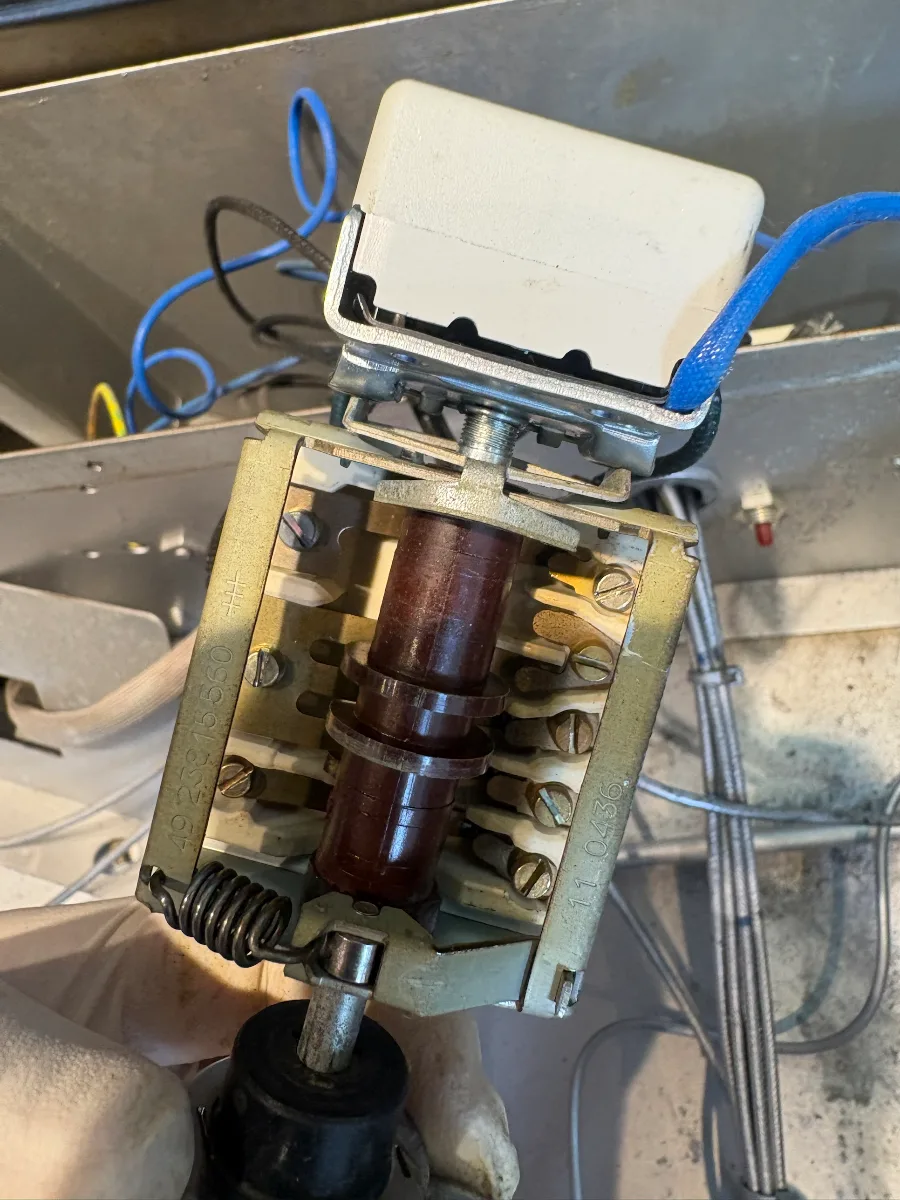
Lacanche oven selector switch removed from the cooker for inspection

A temporary fix the same day

So that the family could cook in the meantime, our engineer removed the switch, cleaned its contacts and refitted it. The oven started working again. This was a temporary measure only: a switch that has burnt once cannot be relied on, so we ordered a replacement.

Why we renewed all the oven controls, not just one switch

Only one part had actually failed. But the thermostat and the high limit switch had been working for the same years in the same heat, and their history was unknown. Replacing just the switch would most likely have meant another call-out, and another wait for parts, when the next old part gave up. The owner agreed to renew all three at once: the selector switch, the oven thermostat and the high limit switch.
On the return visit in November we fitted the three new parts and tested the oven. It is heating normally. In our engineers’ experience, renewing the oven controls in one go like this gives a Lacanche another five to six years without needing attention.

Can I keep using a Lacanche oven with a burnt switch?

No. Burnt terminals mean the connection has been overheating. If your Lacanche oven has stopped heating, or the selector knob feels loose or smells hot, switch the oven off at the isolator and have it checked. A clean cooker also helps: grease and spills that reach the controls under the hob shorten their life, see how to clean your Lacanche oven. If you are choosing between French ranges, see Lacanche vs La Cornue: an engineer’s comparison, and Lacanche vs AGA.

Book a Lacanche repair in London

LE Company’s call-out is from £175 + VAT and includes the first 30 minutes on site, when the engineer finds the cause of the fault. The cost of the repair is agreed with you before any work starts. We repair Lacanche, La Cornue, AGA and other range cookers; see also our electric oven repair and oven repair in London pages, read how we can help with your Lacanche oven, or call +44 203 603 7172, Monday to Saturday, 8am to 8pm. Prices and parts are covered in our frequently asked questions.
Sub-Zero error codes: what they mean and what to do


Most Sub-Zero error codes mean one of four things: a compressor that has run for too long (codes 40, 40 1 40, 40 2 40, 40 3 40 and 50), a defrost fault (21 and 24), a failed temperature sensor (EE) or an ice maker water fault (EC30). This guide from LE Company, Sub-Zero repair engineers in London, lists what each code means according to Sub-Zero’s own help pages, what you can safely do yourself, and when to call an engineer. For repairs, see our Sub-Zero repair in London page.

Sub-Zero error code list

The meanings below are taken from Sub-Zero’s own owner help pages (subzero-wolf.com/assistance). The same number can be shown differently on different series, so check which family your model belongs to.
Code
What Sub-Zero says it means
Models
40 1 40
Excessive run time, refrigerator / zone 1
Classic (BI), Designer / Integrated, wine
40 2 40
Excessive run time, freezer (Classic) or zone 2
Classic (BI), Integrated wine
40 3 40
Excessive run time, zone 3
Designer / Integrated, wine
40 / EC40
Excessive freezer compressor run time
600, 700, PRO 48
50 / EC50
Excessive refrigerator compressor run time
700, Designer / Integrated
24 / EC24
Defrost underheat
600, 700
21 / EC21
Defrost overheat
600
EC30
Ice maker shut off: water valve worked too many times
600, 700
EE
Faulty temperature sensor (left freezer, right fridge)
600, Classic, 700, PRO 48, 400 wine
98 0 98
Brownout: the mains voltage dropped
Classic (BI)
15 1 01
Refrigerator compressor relay stuck closed or electrical interference
Classic (BI)

How a Sub-Zero shows an error code

600 and 700 Series (for example the 632, 642, 650 and 695): the word Service flashes between the temperature displays, and a code may appear as a number alternating with EC, such as EC40. A steady Service light means codes from an earlier fault are still stored.
Classic, formerly Built-In (BI-36, BI-48 and similar): a wrench icon lights or flashes, and codes appear in three parts, such as 40 1 40 or 98 0 98. A flashing wrench with the alarm chiming means a major error code has been logged.
Designer / Integrated (IT, IC, ID columns and drawers): three-part codes such as 40 1 40 and 40 3 40, where the middle number is the zone.
PRO 48: Service flashes on the outside display; behind the grille there is a service display that an engineer uses to read the fault history.
Newer connected models: errors also appear in the Sub-Zero Group Owner’s App, with a yellow triangle for a problem you can usually fix and a red triangle or Service Required when an engineer is needed.

What does Sub-Zero error code 40 1 40 mean?

According to Sub-Zero, error code 40 1 40 means excessive run time: the refrigerator (zone 1) compressor has been running for longer than it should. On Classic (Built-In) models, 40 2 40 is the same fault for the freezer, and on Designer / Integrated and wine models 40 2 40 and 40 3 40 refer to zones 2 and 3. Sub-Zero's advice is to switch the breaker off for 30 seconds, switch it back on and, if the code returns, book a service engineer. A long run time is a symptom, not a cause: the compressor keeps running because the cabinet is not reaching its set temperature. The usual reasons are a dirty condenser, a fan that has stopped, ice on the evaporator after a defrost fault, a door seal that leaks, or a refrigerant or compressor problem. Our guide to why a Sub-Zero fridge stops cooling properly covers these in more detail.

What does EC40 or error code 40 mean on a Sub-Zero?

On 600 Series, 700 Series and PRO 48 models, code 40 (shown as EC40, or 40 alternating with EC) means excessive freezer compressor run time. Sub-Zero lists a door left ajar, a sealed system problem, a fan problem or a temperature sensor problem as possible causes. If the temperatures are high, call an engineer; if they are close to normal, clean the condenser and clear the code. If you clear the code and it comes back within a day or two, the fault is still there and the freezer needs an engineer. See our Sub-Zero freezer repair page.

A real case: error 40 on a Sub-Zero PRO 48

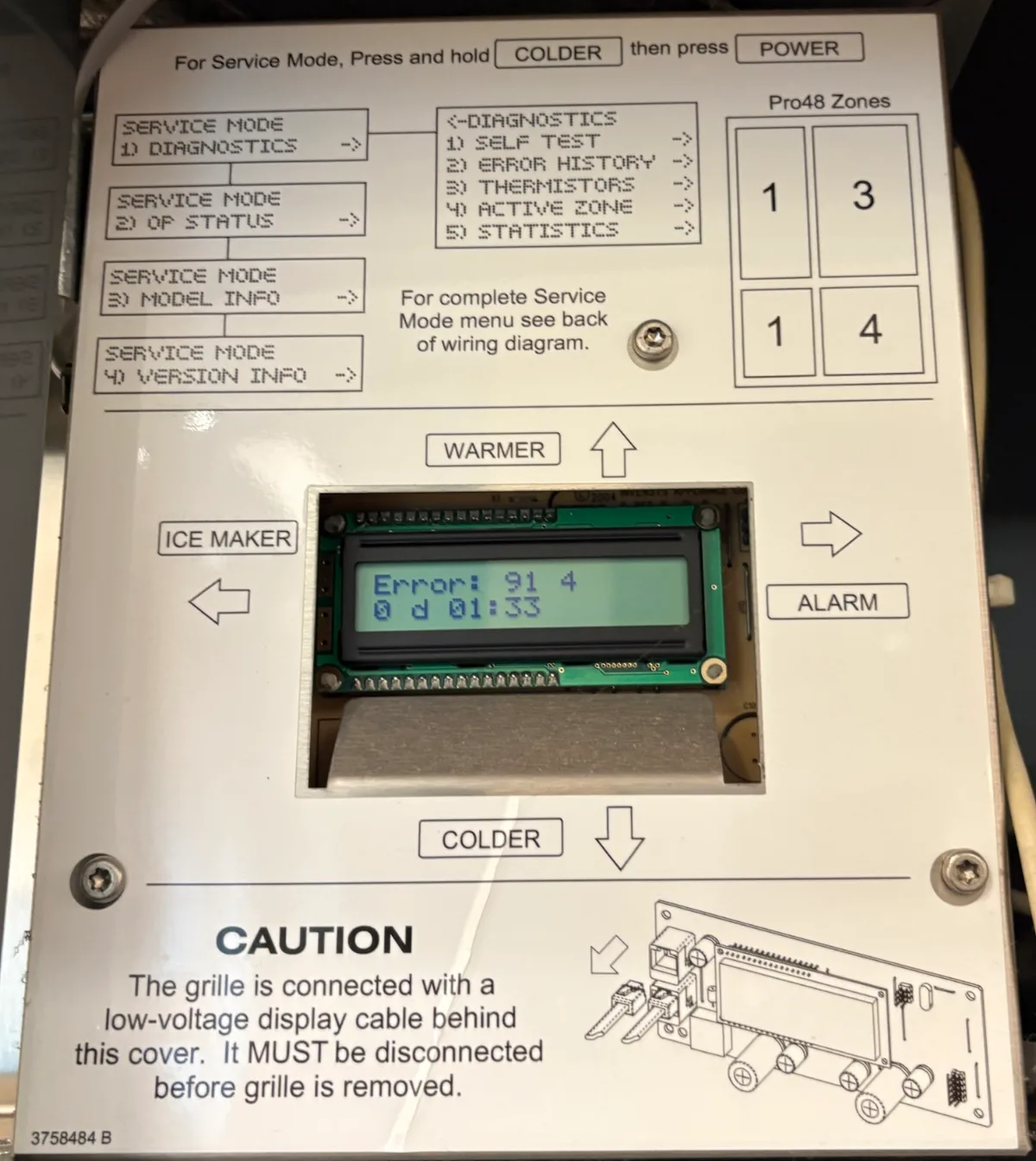
In November 2026 LE Company engineers were called to a Sub-Zero PRO 48 in London whose freezer section had stopped working. The service display behind the grille showed two stored faults: error 40, long compressor run, and Error 91 4, which our engineer read as a fault in the lighting system.
Sub-Zero PRO 48 service display behind the grille showing a stored error code
The freezer compressor did not start in normal operation. With a separate starting device connected it started, and it passed a test with a speed controller, so the next step is to replace the compressor inverter and re-test, and to replace the compressor only if that does not cure it. Error 40 had been the first sign: the freezer was calling for cold that the compressor could no longer deliver.

Sub-Zero error code 24 and 21: defrost faults

Code 24 (EC24) means defrost underheat: the defrost heater did not warm the evaporator as expected. Code 21 (EC21) is the opposite, defrost overheat. Both are listed by Sub-Zero for 600 and 700 Series refrigerators. A defrost fault matters because the evaporator slowly blocks with ice, airflow stops and the cabinet warms up, which then often triggers a run-time code as well. In another case, a Sub-Zero drawer fridge kept tripping the breaker during defrost because the defrost heaters had an earth fault.

Sub-Zero error code 50

Code 50 (EC50) is the refrigerator-side twin of code 40: excessive refrigerator compressor run time. Sub-Zero lists it for 700 Series and Designer / Integrated models. The checks are the same: temperatures first, then the condenser, then an engineer if the code returns.

Why is the Service light flashing on my Sub-Zero?

On 600 and 700 Series models such as the 632, 642, 650 and 695, a flashing Service indicator means the control has detected a fault, most often excessive compressor run time, which can mean a cooling problem. A steady Service light means fault codes are still stored in the control. On Classic models a flashing wrench icon with the alarm chiming means a major error code has been logged. If Service flashes together with the ice indicator, Sub-Zero says the ice maker water valve has been energised for too long; switch the ice maker off and book a repair (see Sub-Zero ice maker repair).

What does EE mean on a Sub-Zero display?

EE means a faulty temperature sensor (thermistor). On 600 Series, Classic and PRO 48 models, EE on the left of the display refers to the freezer sensor and EE on the right to the refrigerator sensor. It is not something an owner can fix: the sensor has to be tested and replaced.

What about PP and other codes?

Sub-Zero does not publish a meaning for every code on its owner pages. We could not find an official meaning for PP, so we will not guess one here. If your Sub-Zero shows a code that is not in the table, take a photo of the display and the rating plate inside the cabinet, and send it to us with your enquiry: our engineers read the full fault history on site.

How do I reset a Sub-Zero error code?

Sub-Zero's general reset is to switch the unit off at the control panel, then switch the breaker off for 30 seconds and back on. On many models a code can also be cleared by holding the door-ajar (bell) key for 15 seconds once the fault is fixed. Only clear a code if the temperatures are recovering: the engineer needs the stored code to find the fault.
Sub-Zero also warns that on Designer and 700 Series models a kickplate fully covered by custom cabinetry can starve the unit of air and lead to a sealed system failure, so check that the grille is not blocked. Keeping the condenser clean is part of regular Sub-Zero maintenance, and it prevents many run-time codes before they appear.

When to call a Sub-Zero engineer

Call an engineer if a code comes back after a reset, if the temperatures are rising, if you see EE, or if the unit trips the electrics. Do not keep resetting it: every reset can hide the stored code the engineer needs. For what a repair usually costs, and whether an older unit is worth repairing, see our Sub-Zero repair cost guide.

Book a Sub-Zero repair in London

LE Company’s call-out is from £175 + VAT and includes the first 30 minutes on site, when the engineer reads the fault codes and finds the cause. The cost of the repair is agreed with you before any work starts, and we fit only original Sub-Zero parts. See our Sub-Zero repair in London page, read our frequently asked questions, or call +44 20 3603 7172, Monday to Saturday, 8am to 8pm.

Sub-Zero drawer fridge tripping the breaker: failed defrost heaters


When a Sub-Zero refrigerator keeps tripping the breaker or the RCD, the fault can be in the defrost heaters rather than in the compressor or the control board. That is what LE Company engineers found this October in a home in Westminster, on a new Sub-Zero integrated two-drawer refrigerator / freezer with an ice maker (model ICBID-30CI). Here is how we traced the fault and what fixed it.

Why is my Sub-Zero refrigerator tripping the breaker?

The customer told us the new Sub-Zero kept tripping the electrical circuit, and it had been switched off by the time we arrived. We removed the front grille and inspected the machine compartment. If your Sub-Zero is not tripping but has stopped cooling, see why a Sub-Zero fridge stops cooling properly.
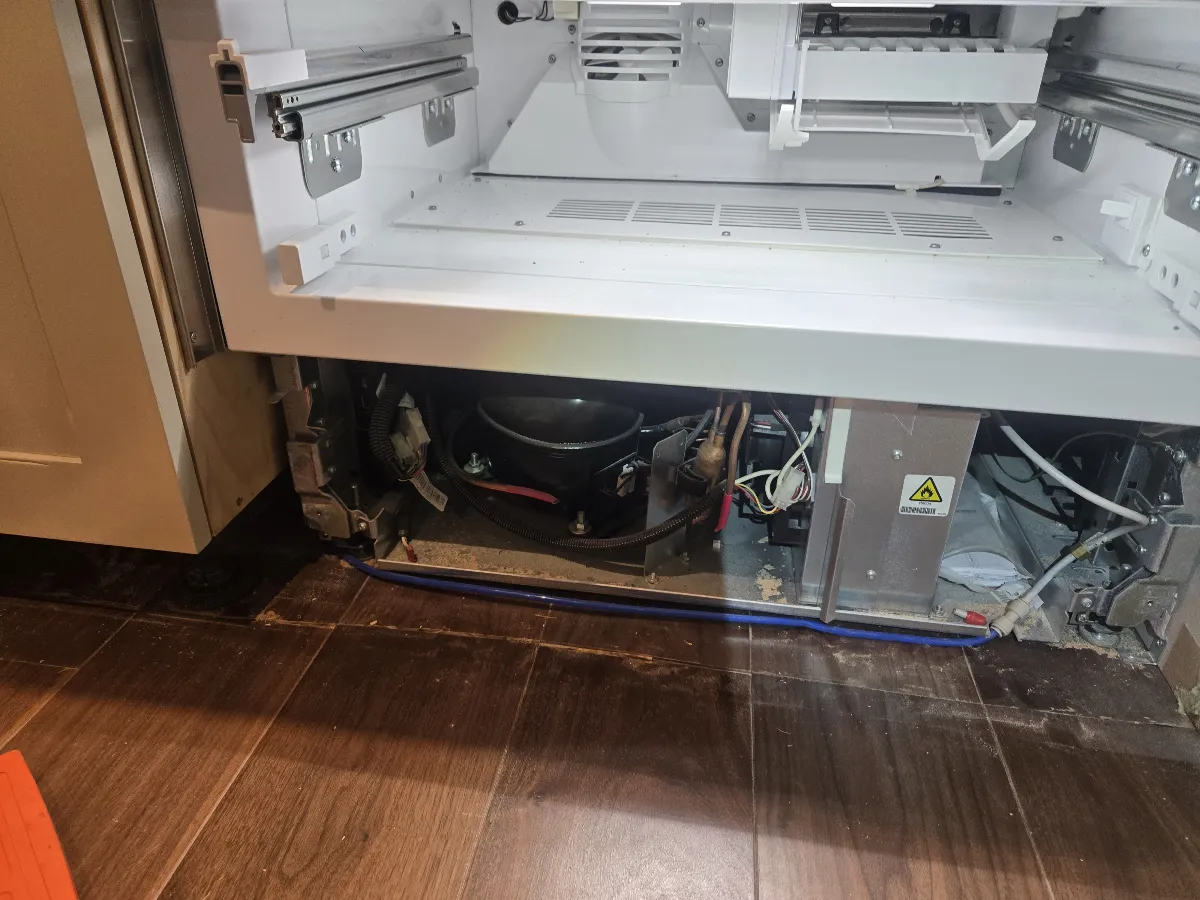
Sub-Zero drawer refrigerator freezer machine compartment with the grille removed

How do you find out what is tripping the RCD on a fridge freezer?

We ran the appliance one function at a time. Everything worked normally, and the ice maker passed a full test (for ice maker faults, see our Sub-Zero ice maker repair page). Then we ran the defrost test, and the RCD tripped as soon as the defrost heaters were energised. There are three heating elements in that circuit on this model.
To rule out the electronics, we removed the main control board and inspected it. It was intact, with no visible damage, so we refitted it. Our conclusion was a fault in the defrost heating elements, and we recommended replacing all three.
Sub-Zero drawer fridge main control board removed for inspection

What should I do if my fridge freezer keeps tripping the RCD?

Switch the appliance off and leave it off until an engineer has found the fault. An RCD trips because current is leaking to earth, so resetting it again and again is not a fix. Our engineers left this Sub-Zero switched off until the new parts were fitted.

The repair: three new Sub-Zero defrost heating elements

On the return visit we replaced the three defrost heating elements with original Sub-Zero parts (part numbers 7025952, 7040522 and 7011756), reassembled the unit, switched it on and tested it. It passed. The earth fault had been in the defrost heaters, as diagnosed on the first visit, and no further work was needed.

Sub-Zero defrost heater faults are worth repairing

A failed defrost heater can make an expensive, almost new Sub-Zero look dead, but it is a repairable fault. Finding it took a methodical test of each function, and fixing it took three original parts. For what Sub-Zero repairs usually cost, and when an older Sub-Zero is worth repairing, see our Sub-Zero repair cost guide.

Book a Sub-Zero repair in London

LE Company’s call-out is from £175 + VAT and includes the first 30 minutes on site, when the engineer finds the cause of the fault. The cost of the repair is agreed with you before any work starts, and we fit only original Sub-Zero parts. See our Sub-Zero repair in London and Sub-Zero freezer repair pages, read the signs your fridge needs repair, or call +44 20 3603 7172, Monday to Saturday, 8am to 8pm. Prices, parts warranty and insurance are covered in our frequently asked questions.
Gaggenau freezer alarm and not freezing: a dust-clogged condenser


When a built-in Gaggenau freezer keeps sounding its alarm and stops freezing, a dust-clogged condenser can be the cause. That is what LE Company engineers found in a home in Belgravia this October: three Gaggenau Vario built-in units, a freezer, a fridge and a wine fridge, had overheated because their condensers were packed with dust, and the heat had damaged their electronics. Here is what we found, how we repaired them and how to stop it happening to yours.

Why is my Gaggenau freezer alarm going off and the freezer not freezing?

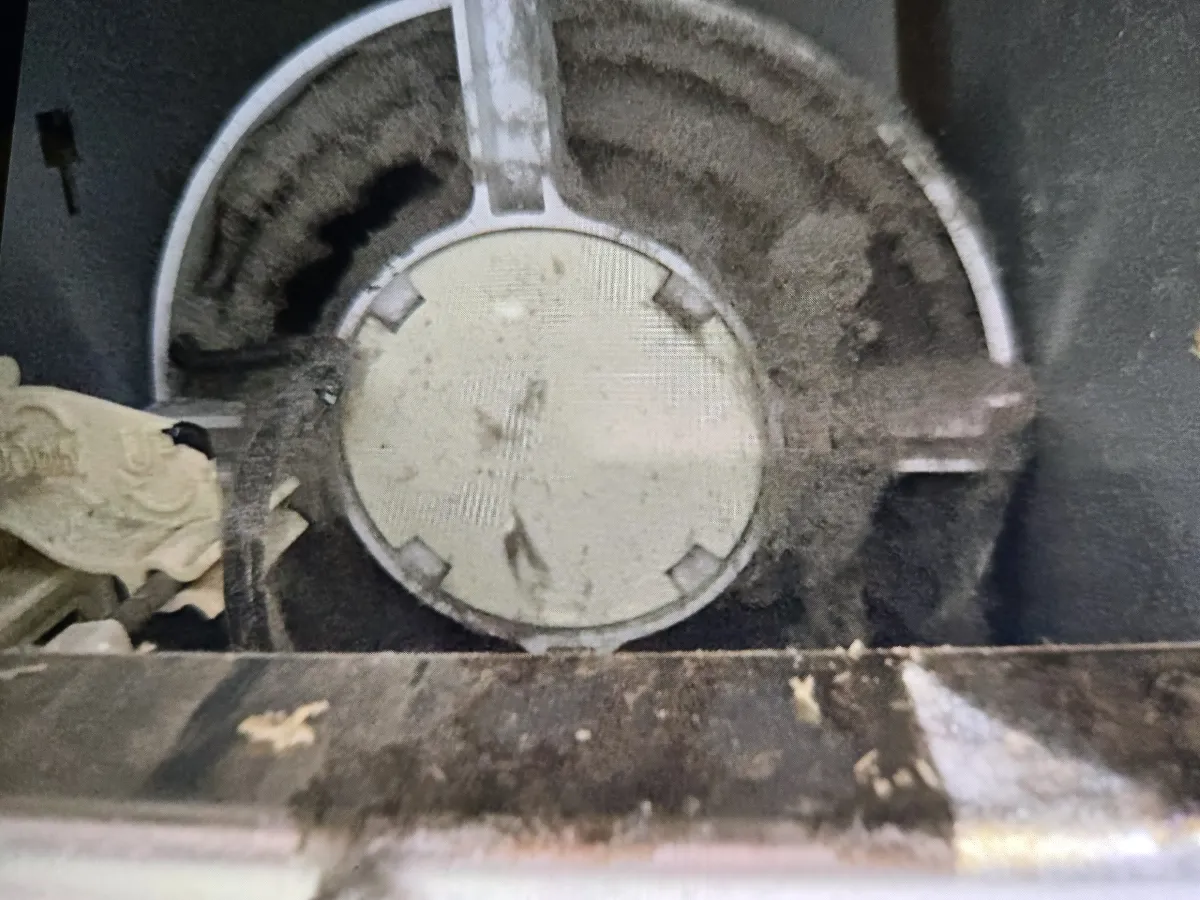
The customer told us the freezer alarm kept going off and the freezer was not freezing. On arrival the freezer (model RF461200) was overheated, and the fridge beside it (RC472200) was in the same condition. Behind the grille, the condenser and its fan were buried in dust and fluff.
Gaggenau freezer condenser and fan clogged with dust
A condenser carries the heat away from the freezer. Covered in dust, it cannot do that, the machine compartment overheats and the freezer warms up and raises the alarm.

What happened to the inverter and the control board

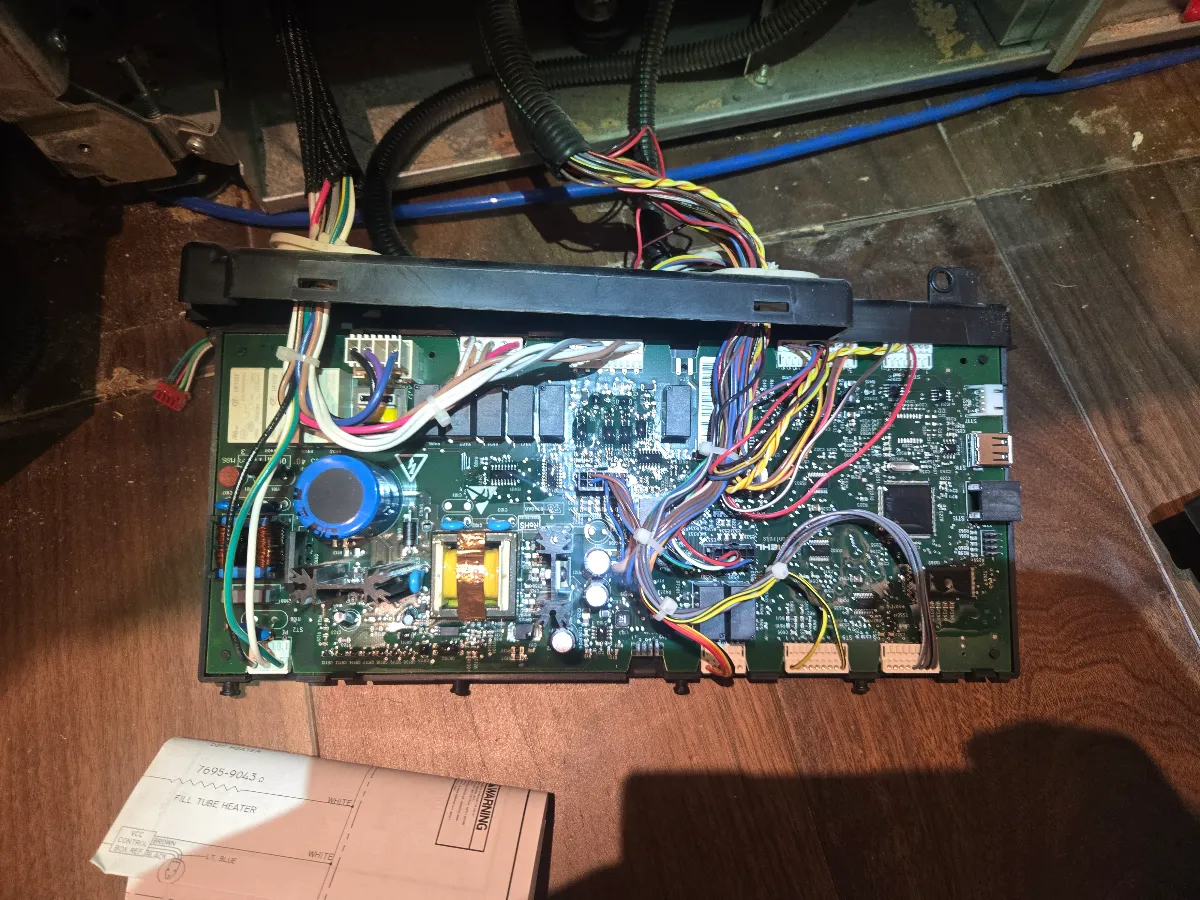
We cleaned the condenser, fan and grille. We then tested the compressor directly with an external inverter test tool, bypassing the freezer’s own electronics: the compressor started, so the compressor itself was fine. The freezer’s own compressor inverter did not respond, and plastic on the control board had melted from the heat. Our engineers concluded that the overheating from the clogged condenser had caused both failures.
Gaggenau freezer condenser after cleaning by LE Company

Can a Gaggenau freezer be repaired after it overheats?

Yes. On the return visit we fitted a refurbished control board and a replacement compressor inverter to the freezer, and replaced one light transformer. The compressor started on the freezer’s own inverter and the freezer cooled normally. The fridge got a replacement inverter and control board, programmed in our workshop before the visit, and it also cooled normally. No further work was needed on either.

Why is my Gaggenau wine fridge not cooling?

The wine fridge (RW414261) on the same installation had the same problem: a condenser and fan heavily clogged with dust.
Gaggenau wine fridge condenser clogged with dust
Its main control board had failed completely and was beyond repair. That board is discontinued by the manufacturer and no replacement is available, so the wine fridge could not be repaired with original parts. We gave the customer two options: replace the wine fridge, or have a custom control board made, measured and specified from the original, then fitted and tested. The compressor can only be tested once a working board is in place.

Gaggenau fridge not cooling: the same cause in another home

In November we were called to a built-in Gaggenau refrigerator that was not cooling in another London home. Its condenser was completely blocked with dirt and overheated, the evaporator had iced up and the evaporator fan was frozen in ice. We replaced the control board, the evaporator fan motor and the cracked defrost drip plate, and the refrigerator was running at the end of the visit, with a final check of the inverter and refrigerant still to come.

How do I stop my Gaggenau fridge or freezer overheating?

Keep the condenser, fan and grille clear of dust, as part of the regular fridge freezer maintenance tasks. In every case described here, our engineers recommended regular condenser cleaning, because the dust-clogged condenser was what caused the overheating and the failures that followed. Dust builds up slowly and out of sight, so it is easy to miss until the alarm goes off, and hot weather makes an overheating fridge worse. Cleaning a condenser costs far less than a new inverter and control board, and much less than losing a wine fridge whose board can no longer be bought. For how often to clean fridge condenser coils and what sets an expensive fridge apart, see our engineers’ guide. Choosing between Gaggenau and Liebherr? Read our Liebherr vs Gaggenau fridge comparison.

Book a Gaggenau fridge or freezer repair in London

LE Company’s call-out is from £175 + VAT and includes the first 30 minutes on site, when the engineer finds the cause of the fault. The cost of the repair is agreed with you before any work starts, and we fit only original manufacturer parts where they are still available. See our Gaggenau fridge repair in London page or call +44 20 3603 7172, Monday to Saturday, 8am to 8pm. For ovens, coffee machines and other appliances, see Gaggenau repair in London and our Gaggenau service guide. For other makes, see fridge repair in London. Prices, parts warranty and insurance are covered in our frequently asked questions.
Sub-Zero repair cost: is it worth repairing a Sub-Zero refrigerator?


A Sub-Zero repair in London with LE Company starts with a call-out from £175 + VAT, and a full refurbishment of a 15-year-old Sub-Zero refrigerator costs about £2,000 on average. Because Sub-Zero refrigerators are built to last for decades, repairing one, or buying an older model and having it refurbished, is usually far better value than buying new. LE Company repairs Sub-Zero fridges, freezers and wine storage across London.

How much does a Sub-Zero repair cost?

A Sub-Zero repair in London with LE Company starts with a call-out from £175 + VAT, which includes the first 30 minutes on site while the engineer finds the cause of the fault. The visit with the assessment is paid first. The cost of the repair itself depends on what has failed and which parts are needed, and it is agreed with you before any work starts.

How much does a full refurbishment of an old Sub-Zero cost?

A full refurbishment of a 15-year-old Sub-Zero refrigerator costs about £2,000 on average with LE Company. The exact price is agreed after the engineer has assessed the appliance.

Is it worth repairing a Sub-Zero refrigerator?

In most cases, yes. Sub-Zero refrigerators are built to last for decades, much like a Mercedes car: the cabinet, doors and hardware stay in good condition for a very long time, and it is usually the parts that wear, such as seals and cooling components, that need attention. Replacing those parts costs far less than a new Sub-Zero.

Is it worth repairing a 20-year-old Sub-Zero refrigerator?

Often it is. Older Sub-Zero models are made from the same quality materials as new ones and, in our engineers’ experience, are often more reliable. After a full refurbishment, a 10- or 20-year-old Sub-Zero can be hard to tell from a new one.

Is it worth replacing the door seal on an old Sub-Zero?

Yes. On a very old Sub-Zero, replacing the door seal is a long, labour-intensive job, but the seal is made to a very high standard, and after this one replacement the fridge can run for another 10 years. Newer models use a push-in seal that is quicker to fit but typically lasts about six years. The extra labour on an older Sub-Zero pays for itself.

Should I buy a used Sub-Zero and have it refurbished?

It can be the best value way to own a Sub-Zero. Many LE Company clients have bought an older Sub-Zero, for example on eBay, and had us refurbish it, and they are very happy with the result. Budget about £2,000 for a full refurbishment of a 15-year-old model on top of the purchase price, and you get a refrigerator in excellent condition for much less than a new one.

How LE Company prices and records a Sub-Zero repair

Every Sub-Zero job follows the same rules:
  • The visit with the assessment is paid first. The call-out is from £175 + VAT and includes the first 30 minutes on site.
  • The cost of the repair is agreed with you before any work starts.
  • We fit only original manufacturer parts. They carry the supplier’s warranty, usually 12 months, and for our regular customers we handle any warranty claim ourselves.
  • The engineer records the serial number of your Sub-Zero and photographs it with any visible defects.
  • Repairs are done on site. A workshop repair happens only in special cases, under a separate written agreement with every timescale and charge agreed in advance.

Book a Sub-Zero repair or refurbishment

To book an engineer, see our Sub-Zero repair in London page or call +44 20 3603 7172, Monday to Saturday, 8am to 8pm. If your fridge has stopped cooling, read why a Sub-Zero fridge stops cooling properly, and for an example of an older fridge we brought back, see a Sub-Zero that was nearly thrown away. If your Sub-Zero is tripping the breaker or RCD, the defrost heaters may be the cause. If it shows a fault code, check our Sub-Zero error codes list first. If you are choosing a new fridge, read are expensive fridges worth it. Prices, parts warranty and insurance are covered in our frequently asked questions.

How LE Company became the best Sub Zero repairing company in London


At LE Company, we are proud to say we are the best Sub Zero repairing company in London, with a strong reputation for excellence. We have built this reputation through outstanding technical mastery, access to genuine parts, and an A-rated customer-focused service. We worked hard and succeeded.

We ensure outstanding mastery and access to genuine parts

Outstanding mastery in Sub Zero repairs

Our outstanding Sub Zero repair mastery rests on at least three pillars:
  • Ongoing training in Sub Zero technologies: This ensures a thorough, up-to-date understanding of the complex engineering inside
  • Extensive experience in Sub Zero repairs: Each completed case deepens our hands-on expertise in evaporator, magnetic sealing, and other system-specific repairs
  • Full assessment and after-repair testing: Must-do activities to ensure the root cause is detected and addressed

Access to genuine Sub Zero parts

In addition to outstanding mastery, at LE Company, we built strong relationships with reliable suppliers who stock factory-certified parts.
This access to genuine Sub Zero parts gives us a significant competitive edge. To clarify, when dealing with Sub Zero appliances, using anything other than genuine or officially compatible parts puts the appliance under a major risk – from compromised performance to damaging its sensitive components. When turning to us, Sub Zero owners can rest assured no such harm will come to their fridges, protected by the exact parts the manufacturer designed it to use.

We provide A-rated customer-focused service

At LE Company, we ensure deep commitment to our customers’ needs. Our service includes:
  • Same-day visits for emergencies to save our customers from stress and address the issue in the shortest time
  • Clear communication and punctual arrivals so as not to waste our customers’ time
  • Care for our customers’ kitchen and delicate touch to avoid damaging expensive cabinetry
  • Spotless finish to leave the customers’ kitchens clean of any repair work trace and debris
  • Follow-up advice as a standard part of our Sub Zero service

Conclusion

So, we became the best Sub Zero repair company in London by focusing on two major aspects:
  • Reliable repair results – built on deep factory-level training, a strict assess-and-test approach, and genuine parts.
  • A flawless customer experience – delivered through rapid responses, same-day emergency visits, care for the customer's cabinetry, and professional Sub Zero maintenance tips.

Recent job: Why clients want to resuscitate Gagganau ovens


One of the recent jobs we did regarding Gaggenau service was two days ago in Chelsea. It was not an emergency but a regular visit to one of our clients who we visited some time ago regarding his fridge. This time he contacted us stating that he had moved into his dad’s house where is a Gaggenau oven that is more than 14 years old and that was not functioning and hence not used for about 3 years.
Apart from not being a working oven, it was also not cleaned or serviced for a long time. The initial assessment also showed that someone had already tried to repair some of its parts and decided to use the low-quality spare parts, which made the oven working only for a short period.

What we did

Firstly, we did the initial assessment, prepared an estimated quote, so the owner would make a proper and final decision. The repairing of the ovens in a such condition is a good and fun challenge for us and we know that we can definitely bring it back to life and make it working for a minimum 6 extra years, but it is not cheap for the owner. Yes, it is not as expensive as buying a new gaggenau oven but it is definitely about the time that we will require and still the money, which could cover at least 1/3 or even ½ of the new appliance.
The decision was still the same – do the repairing and service. So now we are already in the process of bringing it back to life. Our assumption that it may take for about 2 to 4 weeks depending on the original spare parts delivery. Plus, we want to refresh its sides painting.

Conclusion

Finally, the resuscitation of the old ovens is something what we do, but we are always honest with our clients and we want them to make a rational decision. This case is special, as the client wants to keep the oven as a memory about his father. We respect that and will do our best as usual to make it working for ages again.

Recent job: How we gave the second life to a wolf oven


One of our clients left us a Wolf oven about four months ago in London. It was broken and he decided to get a new one and found our company to perform installation. However, his broken oven had to be removed before that, in order to avoid the process of getting rid of it he asked if we could take it. That was a deal.
We performed the installation and he was left absolutely happy having his new Wolf oven and having no extra job with the old one.

The old Wolf oven

The old oven was delivered into our warehouse and left there. We had a plan of running an assessment of each part, remove the working ones and use them as the original spare parts as they are always in need.
We want to highlight that Wolf stove repair is one of our regular services we perform weekly, but sometimes our clients even ask us if we can help them finding a specific oven they need. This is what happened two weeks ago from today. Our admin team started the search and after about two-three days we realised that the Wolf oven that we had collected and kept is exactly the one the new client was looking for.

Our solution

The problem was that a few parts were already removed from the oven and we had to put them back plus repair the not working parts. The job was finished this morning. The Wolf oven is now fully working and ready to serve a new owner for the next 6-8 years (depending on care).
We love such cases, we love challenges, so if you need some electrical or gas engineering services, feel free to give us a call.

How to get the best time for an engineering service


Engineering service is something that most of our clients do not plan and indeed it is something that you cannot foresee. About 65% of our clients call us in the emergency situations, such situations can happen on any day at any time. The emergency cases make service more expensive and inconvenient to resolve. Based on the cost and the inconvenience we decided to create this article to explain the difference between the call out types and what options our customers get.

Regular call outs

This is the main call out approach that can be chosen. Imagine that you have an oven that has something faulty or looks like it is going to break down soon and you decide to find an engineer in advance. This is the case when you will be offered a regular call out price and the time slot that is very likely will meet your availability.
Such cases are good for us as we can leverage the pressure and it is good for you because you will pay the regular call out price plus meet us at the best time you can. However, such cases happen not that often.

If emergency

If you have faced an emergency situation, like you are running a small restaurant and have a party booked for the Friday evening and your oven stops working on Thursday. The emergency as it is. Well, in that giving a call to us you will expect an engineer to come as soon as possible, but we may have a few emergencies on that day already and some spots require more than one engineer, therefore even your case may require you to wait us to visit you after 10 pm if you need your oven to be repaired before Friday. Moreover, such case will cost you almost twice more rather than the regular call out.
It is very logical that you may think that how it can be solved then? Because it is not easy to predict the breakage of any appliance, unless it is a small sign at first.

Solution that our engineering company can offer

At LE Company we know how important it is having all the appliances working in a good condition and we also know how important it is to save money by reducing the costs. Therefore, we always strongly suggest having regular maintenance service, which will:
  • Maintain the appliances in a good condition
  • Predict and prevent the emergency cases
  • Save you money
You can rely on our engineering company in London. We know how to make things working.

How to choose a good oven engineer in London


In short, to choose a good oven engineer in London, check their legal competency for your oven type first and then filter for expertise relevant to your oven brand.

Check the legal competency

Under UK law, working on gas and electric ovens requires different legal competencies. Besides, for any oven repairs in London, a reputable engineering company should have public liability insurance.

Legal competency for electric oven engineers

To deal with an electric oven, a good oven engineer must have the specific trade membership. In other words, they must have a valid electrical certificate to ensure they will follow a code of practice when working on your electric oven.
At LE Company, our oven engineers have 17th Edition electrical certificates, which makes us a reliable point of contact for any tasks related to electric ovens.

Legal competency for gas oven engineers

To deal with a gas oven, a good oven engineer must be on the Gas Safe Register, qualified for the specific appliance type in separate. In short, there are the following core competencies:
  • For domestic oven repair and maintenance: Cookers LPG, Cookers NG, Range Cookers LPG, Range Cookers NG
  • For caravanners oven repair and maintenance: Caravans Cookers LPG
  • For commercial oven repair and maintenance: Commercial Catering Range Cookers LPG, Commercial Catering Range Cookers NG
At LE Company, we have all the competencies listed above, which makes us a universal go-to service for any gas oven repair and maintenance task in London.

Check the expertise

Whether it is for gas or electric, domestic or commercial ovens, there is a wide range of manufacturers on the market. Often, they apply their specific technologies and engineering solutions. And luxury brands especially. In other words, when choosing an oven engineer, make sure your candidate has expertise relevant to ovens of the same manufacturer as yours.
At LE Company, our oven engineers have deep expertise and vast experience in all the brands popular in London, including luxury brands such as Gaggenau, Viking, La Cornue, and many others. This makes us one of the leading oven repair companies in London.

Conclusion

So, if you have a domestic gas oven, choose an engineer that has a CCN1 core with the CKR1 or CKHB1 code, depending on your oven type. If you have a commercial gas oven, choose an engineer that has CCCN1 core with the COMCAT code. If you have a domestic gas oven installed in a commercial property, choose an engineer with both CCN1 and CCCN1 cores.
And of course, make sure that an engineer is trained on your oven brand and is fully insured for their public liability.

Common Viking issues and how to deal with them: LEC guide


Common Viking issues fall into the issues with gas cooktops and issues with fridges. In short, for Viking gas cooktops, common issues include orange flames and a gas burner that won't light. For Viking fridges, the most common issue is that an appliance stops cooling effectively.
In this post, we will provide you with a guide on why these Viking issues may arise and how to deal with them. If you have these or any other issues and need a reliable Viking repair service, you can count on us.

Orange flames

Cause of the Problem

Orange flames appear when gas isn’t burnt completely. At LE Company, we typically detect three causes of the issue:
  • Clogged burner inlet
  • Clogged burner ports
  • Drifted air shutter

How to Resolve

At LE Company, we recommend trying simple DIY maintenance to address orange flames first:
  • Clean the burner head ports with a straight pin
  • Remove the burner head and clear debris from the area beneath
If this doesn’t help, then turn to qualified engineers for air shutter adjustment.

Gas burner clicks but won't light

Cause of the Problem

As for the burner that won't light, the common causes include:
  • Misaligned burner cap
  • Dirty igniter
  • Failed spark module

How to Resolve

To address a burner that won’t light, we recommend trying simple DIY maintenance first:
  • Pull and reseat the burner cap to fix its misalignment
  • Clean and dry the igniter to get rid of a conductive film created by spills and moisture
If this doesn’t help, then turn to professionals for module replacement.

Viking fridge stops cooling effectively

Cause of the Problem

Based on our experience, at LE Company we compiled the following list of possible causes for a Viking fridge getting warm:
  • Blocked air vents
  • Frost-blocked evaporator coils
  • Torn door gasket
  • Failed evaporator fan motor

How to Resolve

To resolve the issues, start with simple DIY activities:
  • Make sure the vents are not blocked
  • Move food away from the vents, if necessary
To address a frost-blocked evaporator coil, you can unplug the fridge for 24 hours with the doors open to melt the ice block. However, if frost returns within a week, it means the defrost system has failed and needs professional repair.
To repair the evaporator fan motor or replace a torn door gasket, turn to an experienced engineer.

Conclusion

Steps to resolve the issue may differ depending on the exact cause. To clarify, while some causes are DIY-friendly to fix, others should be addressed only by professionals.
For a Viking range that doesn’t ignite or produces orange flames, the DIY fixes are possible only in case of a clogged burner inlet or ports, a misaligned burner cap, a dirty igniter, respectively.
For a Viking fridge that stops cooling effectively, the DIY fixes are possible only in case of blocked air vents or frost-blocked evaporator coils.
For other faults, you need professional assistance.

Start preparing your oven for Christmas 2026


October and November are the ideal time to start preparing your oven for Christmas 2026. At LE Company, we advise starting with cleaning the oven interior and then moving to a thorough check-up, while entrusting specific maintenance tasks to professionals. And, of course, turning to a professional oven repair service, if necessary.

Start with cleaning the oven interior

Why you need to clean the oven interior

Oven interior cleaning is one of the basic procedures we recommend at LE Company to our customers when they start preparing their oven for Christmas.
Here are a few reasons why proper cleaning is highly important:
  • Old food residues are a breeding ground for bacteria and impose risks to food safety
  • Burned-on residues spoil the food taste and fill your kitchen with smoke
  • Residue on the door seal prevents proper sealing

Items to clean

When cleaning your oven interior, pay special attention to at least the following areas:
  • Racks: Soak them in hot, soapy water and scrub away any baked-on residue
  • Door seals: Wipe seals gently with warm soapy water, but avoid harsh chemicals that could degrade the material
  • Walls, bottom, and glass door: Apply a baking soda paste or a manufacturer-approved dedicated cleaner in a thick layer and treat the surfaces gently with a non-abrasive sponge

Continue with a thorough check-up

Components to pay special attention to

At LE Company, we recommend paying special attention to at least the following components when preparing your oven for Christmas:
  • Door seal: With poor door sealing, heat escapes, which results in longer or uneven baking
  • Fan motor: Without circulation, hot air doesn’t distribute evenly, which results in uneven browning and hot spots
  • Thermostat accuracy: When an oven runs hotter or cooler than the dial says, your turkey may be raw in the middle or the roast burnt.

Pre-Christmas preparation tasks you can safely do yourself

Within a pre-Christmas check-up, we recommend simple DIY-friendly activities:
  • Clean the interior and check the door seal
  • Test every mode with a trial cook
  • Verify the thermostat (an oven thermometer required)

Pre-Christmas servicing to entrust to professional engineers

There are some dangerous tasks you should never do yourself. Instead, for such tasks the only right step is to turn to professionals like LE Company:
  • Gas supply, injector, or ignition repairs
  • Casing opening or dealing with wiring or the thermostat
  • Door seal, fan motor, element, or thermostat replacement.

Conclusion

So, about 80% of pre-Christmas oven preparation is cleaning, inspecting, and testing, which is DIY-friendly. What you can't safely do yourself is anything involving gas, the electrical internals, or part replacements. For these, always turn to a certified engineering company.
Home › Wolf Oven Repairs › Recent: Wolf oven was not serviced for 4 years

Recent: Wolf oven was not serviced for 4 years


Wolf ovens can be considered as the most popular ovens among the luxury in London. It is not a fact but we deal with them quite often. One of the recent works we did was in Kentish Town, where the house owner has even two wolf ovens and one of them was broken. It had a problem with a stove ignition as we thought, however it was not that obvious as we expected. The main reason was simple but highly serious – it was not serviced and cleaned for about 4 year.
We stated it many times that cleaning and servicing are required at least once a year! Any oven has to be not only wiped by a napkin. Each oven has to be disassembled into the main parts and each has to be properly cleaned and maintained if required.
The service took us for about an hour for the proper cleaning and 20 minutes to repair and test the ignition part.
Take care of your appliances in advance and they we work longer! Know more about the service by visiting Wolf oven repairs page.
All the best,
LE Company

How to prepare your appliances for Christmas by LE Company


When you choose LE Company, there are just two simple steps you need to follow to prepare your appliances for Christmas. First, arrange pre-Christmas maintenance visits in advance. Second, arrange maintenance for the most crucial appliances at least.

Arrange pre-Christmas maintenance visits in advance

At LE Company, we always advise our customers to start preparing their appliances for Christmas in advance. Here are a few reasons why we recommend not putting off preparation until the last few days before Christmas:
  • Late bookings risk there being no slot available
  • A part ordered in late December may not arrive until January

To clarify, December is the busiest period for electrical engineers in London. Sometimes, we even have to stop taking new bookings by mid-December. So, if you send us your service request just a week before Christmas, we simply may not have a slot to schedule our visit to your home. Besides, over the holidays, parts are rarely held in stock and the delivery time may increase drastically as suppliers shut down or run reduced hours.

Arrange maintenance for at least the most crucial appliances

At LE Company, we recommend arranging pre-Christmas maintenance at least for ovens, fridges, and dishwashers. If you have other appliances you rely on over Christmas, mention them when booking, and we will include them in the visit. We check every component that typically fails under extra load, so you can rest assured your Christmas will not be ruined by a breakdown.

Ovens

Our pre-Christmas oven preparation visits typically cover:
  • Electrical safety check – to ensure the plug, cable, and circuit will withstand the increased load
  • Door seal inspection – and replacement if the gasket is split, hardened, or no longer magnetic
  • Fan motor test – checking for grinding or slow rotation, replacing the motor or blades if necessary
  • Grill element inspection and testing – cleaning or replacing the element if corroded
  • Thermostat check – verification the temperature against a calibrated thermometer, adjustment or replacement, if necessary

Fridges

To prepare your fridge for Christmas, our maintenance visits typically cover:
  • Electrical safety check – to ensure the plug, cable, and circuit will withstand the increased load
  • Condenser coil cleaning – vacuuming or brushing the coils to restore cooling efficiency
  • Temperature verification – running a thermostat check against a calibrated thermometer
  • Door and seal inspection – to ensure the door closes and seals correctly
  • Defrost drain check and cleaning – to prevent water pooling

Dishwashers

For dishwashers, our pre-Christmas maintenance visits typically cover:
  • Electrical safety check – to ensure the plug, cable, and circuit will withstand the increased load
  • Filter clean and drain check – to clear the filter and ensure the pump drains freely
  • Inlet and drain hose inspection – and replacement if the hose is cracked
  • Door seal inspection – and replacement if necessary
  • Door interlock test – to ensure the machine starts, locks, and completes a cycle successfully

Conclusion before Christmas

So, to be sure your appliances will withstand the increased load they have at Christmas, requesting a maintenance visit in November or at least early December is a wise idea. When arranging pre-Christmas maintenance, focus on at least your core appliances – cooking, refrigeration, and dishwashing.
Home › Wolf Repairs › Wolf Oven Usage Guide by LE Company

Wolf Oven Usage Guide by LE Company


While your Wolf oven is a treasure itself, it is worth learning how to make the most of it. In this post, we provide a brief usage guide to help you get familiar with your Wolf oven – covering first-time use, key cooking modes, and general maintenance to keep it running at its best for years.

Please, remember, if you need Wolf oven repair in London, you can always count on us.

First-time use guide

Before using your oven for the first time, run it at a high temperature to burn off any manufacturing oils. As the oven gets hot, you may notice some smell – this is normal. Complete the cycle, let the appliance cool down, and wipe inside with a damp cloth.

At LE Company, we recommend applying the following modes and temperatures for the burn-off:
  • Electric Ovens: Roast mode at 550 F – for a full hour
  • Gas Ovens: Bake mode at 500 F – for 30 minutes, then Broil mode for a further 30 minutes.

Use and care guide

Cooking modes your Wolf offers

Wolf ovens offer a wide range of cooking modes. Here is a breakdown of the most useful ones:
  • Convection: Delivers even and faster cooking. Great for multi-rack baking.
  • Convection Roast: Delivers deep browning and crispness. Great for roasting meat and vegetables.
  • Bake: Keeps items moist without over-browning. Great for baking cakes and quiches.
  • Broil: Delivers intense top-down heat. Great for searing steak, browning, and toasting.
  • Bake stone: Delivers a crisp bottom crust. Great for pizza and artisan bread. Requires the Wolf bake stone accessory.

General Wolf oven maintenance tips

At LE Company, we recommend cleaning spills immediately after each use. Before cleaning, let your oven cool down. Then wipe the interior with a damp cloth. Use a mild detergent, if necessary.

Avoid using Self-Clean more often than just a few times per year. To clarify, running this mode puts significant stress on the appliance and risks of premature wear and tear on its components.

Summary

So, let’s make a brief summary about how to use your Wolf oven:
  • Before first use, run a burn-off cycle for one hour
  • Use the Convection mode for even and faster baking
  • Use the Convection Roast mode for crispy meats
  • Use the Bake mode for delicate items like cakes
  • Use the Bake Stone mode for pizza
  • Use the Broil mode for searing
  • Clean spills promptly by hand. Use Self-Clean mode only 2–3 times per year, as it puts stress on components
Home › Gaggenau Repairs › Gaggenau Dishwasher Not Draining

Gaggenau Dishwasher Not Draining


In short, a Gaggenau dishwasher not draining may typically result from two main causes – clogs and blockages or mechanical failures.

Clogs and blockages

Typically, clogs and blockages may be caused by food debris, grease, or glass fragments. While you can easily address some blockages yourself, other issues may require professional Gaggenau dishwasher repair.

Clogs and blockages you can address yourself

At LE Company, we build the list of issues to check first if your Gaggenau dishwasher is not draining:
  • Clogged filters (at the bottom of the tub)
  • Clogged drain pump impeller (underneath the filter)

To troubleshoot the clogged filter, pull out the filter and wash it with warm soapy water. To troubleshoot the clogged drain pump impeller, reach in with tweezers to pull out blocking glass fragments or food debris.

Clogs and blockages to turn to professional service

Apart from a clogged filter or drain pump impeller, there could be more severe issues for a Gaggenau dishwasher is not draining:
  • Clogged check valve (the valve that prevents backflow)
  • Clogged drain hose (the hose connected with the sink drain or garbage disposal)
  • Clogged or jammed drain valve (the valve that opens to release water)

Typically, at LE Company, it takes us 15 – 30 minutes to troubleshoot the clogged drain hose and 20 – 40 minutes to troubleshoot an issue with the check valve. A clogged or jammed drain valve requires more extensive disassembly. Typically, it takes us 1 – 1.5 hours to fix this issue.

Mechanical failures

Mechanical failures are the most severe issues. Addressing such failures is not a DIY task but requires professional assistance.

At LE Company, we build a list of common mechanical failures that lead to drainage problems:
  • Broken drain impeller (can’t physically push water out of the dishwasher)
  • Burned pump motor (drain pump not working at all)
  • Faulty control board (can’t send power to the drain pump)
  • Faulty drain solenoid (can’t open the drain valve)

Typically, in all these cases, the component needs replacement. Fortunately, with the component in stock, our engineer can fix any of these issues just in one go.

Conclusion

To summarise, a Gaggenau dishwasher not draining is typically caused by either clogs and blockages or mechanical failures.

Minor issues, such as a dirty filter or a blocked drain pump impeller, can often be resolved with simple DIY cleaning. A clogged drain hose, check valve, or drain valve are more complicated problems and require professional attention. The most serious cases involve mechanical component failures (a broken impeller, burned-out motor, faulty control board, or defective solenoid) and almost always demand part replacement by a qualified technician.

If you need our help, we are always at your service. Visit our contact page.

LE Company July 2026 Updates


This is an article with some updates about our engineering company and the service we provide in London. We always improve our current services or expand the range of the services we provide along with the brands we cover. Within the last two months some of our engineers had to deal with two new major brands, which we cover now. Both will be discussed below.

Rangemaster range cookers

Rangemaster is a high quality range cooker that is a very popular appliance used by those who love cooking in London. Our professional engineers are capable to perform full assessment, service or repair of a Rangemaster. Visit Rangemaster repair page to know more.

Lincat Appliances

Lincat is a commercial brand that covers different brand appliances like:
  • Blu
  • FilterFlow
  • Specialist
  • Panther and Seal
  • Invoq and CombiSlim
  • Phoenix and Convector
  • Lynx Prime and Lynx400
  • Opus 800 and Silverlink 600

All of them are different but our engineers know how to deal with any of them. However, if you need to know more about it visit our Lincat repair in London page.

How to look after your grill during the summer season


While enjoying the delicious cooking that your grill provides, do not forget about the maintenance it needs. Proper in-season care not only helps to prolong its lifespan and reduce the need for a grill repair service. It also helps to ensure your cooking is free from any unwanted off-flavours.

In this post, we will discuss how to look after your grill during the summer season.

Crucial maintenance tips

Quick cleaning after every use

To ensure your grill hygiene, keep the unit clean. So, after every use, arrange a quick cleaning for your grill:
  • Spray the grates with lemon juice or rub the cut onion along the hot grates, use tongs
  • Cool the unit down slightly and scrub the grates with a wire brush
  • Apply cooking oil to the grates to prevent rust

Deep cleaning after heavy use

Arrange deep cleaning at least every 3-4 cooking sessions. If you had a lot of cooking, arrange deep cleaning in addition to quick cleaning right after the cooking:
  • Burn off any residue by running your grill on high heat for 10 minutes, the lid closed
  • Soften built-up grime by soaking the grates in hot soapy water once your grill is cool
  • Get rid of the grime by scrubbing the grates with a stiff brush
  • Check for rust and scrub it away, if any
  • Dry the unit and apply cooking oil to the grates to prevent rust

Other maintenance tips

Quick scrape for pre-start

Even if your grill is in good condition after the previous use, it still needs pre-start care. To clarify, after reaching the right temperature and before putting food on it, give the grates a quick scrape to remove moisture and light rust that may have formed.

Managing the ash and drip tray

Grilling produces a lot of fat and juices that flow into the tray. The summer warmth can turn old grease rancid, which will create unpleasant odours when you use your grill next. So, after every use, once your grill is completely cool, empty the ash (for charcoal grills) or the drip tray (for gas grills).

If a sudden rain hits while you are cooking, once it stops and the coals have cooled, empty the ash immediately. Leftover wet ash turns into corrosive sludge and rots your grill metal.

To conclude, it is necessary to add that proper grill care also includes proper storage. To clarify, when your grill is not in use, keep it dry and use a weather-resistant grill cover to protect it from rain and moisture.

Recent: Sub Zero at Hamilton Terrace


Recently we repaired Sub Zero fridge at Hamilton Terrace in London. Most of the calls we receive these days are about faulty air conditioners and fridges. The heatwave in Europe and the UK affect these appliances the most, as the temperature in the flats goes over 28-30 degrees. For the fridges, you either have to cool down the room temperature using the air con or if you do not have an air con then the only thing you can do is to keep as much space inside the fridge as possible.

Another thing we suggest is to keep some space between the fridge and the wall it is attached too.

In case if your fridge is already faulty then do not hesitate contacting a professional engineering company like us.