Miele error codes: what they mean and what to do


A Miele error code tells you which system has stopped the appliance: on a dishwasher F11 is a drain fault, F24 a heating relay fault and F70 the Waterproof leak protection; on a washing machine F11 is a drain fault and F20 a heating fault; on a coffee machine F73 means the brew unit cannot return to its start position. The meanings below are taken from Miele UK’s own customer assistance pages and operating instructions, and LE Company, which repairs Miele appliances in London, adds what our engineers check. Many codes clear after the first steps Miele gives; if a code comes back, the appliance needs an engineer. For repairs, see our Miele repair page.

Miele dishwasher error codes

Older Miele dishwashers show numbered codes such as F11 and F70. Newer ones, the G 5000 range from 2019 and the G 7000 range, show most faults as words: “Drain” instead of F11, “Waterproof” instead of F70, and a general “Fault F…” for the rest. F78 is the one number those manuals still list.

What does F11 mean on a Miele dishwasher?

F11 is a drain fault: the drain pump is blocked or the non-return valve is not seated properly, and water is left in the cabinet. Miele’s first steps: unplug the machine, scoop out the water, clean the non-return valve and the drain pump, turn the pump impeller by hand, refit the filters and restart. On G 7000 and G 5000 Discovery machines built from 2019 the lower spray arm comes out first, and the part is called the drain pump cover. If F11 returns, call an engineer.

Miele dishwasher F24

F24 is a fault in the heating relay contact. There is nothing for the user to do: Miele says to book a repair.

Miele dishwasher F70: the Waterproof system

F70 means the Waterproof leak protection has tripped: the programme stops and the drain pump runs. Miele says to close the stopcock, switch the machine off and unplug it, then call service. Leaks are the subject of our Miele dishwasher leaks guide.

Miele dishwasher F14, F78 and F79

F78 is a blocked circulation pump, usually one that has dried out after a long break or at first use. F14 can be the same stuck pump, or a fault in the water intake or the pressure and heating level switches. For a stuck pump, Miele advises pouring 1 litre of warm water (no hotter than 75 °C) with 3–5 drops of rinse aid into the cabinet, waiting 5 minutes and restarting, two or three times. F79 is a circulation pump fault and needs a repair.
Not every dishwasher fault shows a code. In October 2026 we attended a Miele G 6260 whose door lock had broken: a piece of the lock had snapped off inside the door, and both the door lock and the door opener had to be replaced. See our Miele dishwasher repair page.

Miele washing machine error codes

F11: drain restricted. The drain hose end is more than 1 m high or kinked, or the drain filter or pump is blocked. Straighten the hose, drain the water slowly through the drain filter (it can be hot), clean the filter and check the pump impeller turns.
F20 or “Heating fault”: either Thermostop, where the programme simply pauses until the water reaches temperature, or a heating fault. Disconnect from the mains for at least 2 minutes and restart; if it persists, call an engineer.
F10, “Water inlet fault” or the Check inlet light: water is not coming in. Open the stopcock, clean the inlet filter and straighten the hose. Miele’s test for pressure: a fully open stopcock should give at least 5 litres in 15 seconds.
F1: a short circuit in the water temperature sensor circuit; it needs a repair. Do not confuse it with the “i” light and a “1” in the display, which is not a fault: it is a reminder that no wash above 60 °C has been run for a long time. Run Cottons at 90 °C with a machine cleaner or powder detergent.
F220: the machine is leaking. Miele notes it can also appear by mistake: disconnect, check for water, and if there is none, reconnect and run a programme.

Miele oven error codes: F44, F10 and F235

Oven F44: a technical fault. Miele says to switch the power off at the circuit breaker for 20 seconds; if F44 comes back, call an engineer.
Steam oven F10: a water inlet fault. The feed pump may have dried out after a long time unused, the suction hose in the water container may be missing or badly fitted, or, with a reverse osmosis system, the water may be too pure for the oven to detect. Steam oven F235: an electronic module fault, which needs a repair. Read why Miele ovens are built to last.

Miele tumble dryer error codes: F2 and F66

F66 (often searched as 066) is mostly dirty fluff filters or a dirty plinth filter. It can also be an overloaded drum, a blocked ventilation grille under the door or a poorly ventilated room. Clean the fluff and plinth filters, vacuum the heat exchanger gently and reduce the load. F2 is an open circuit at the refrigerant temperature sensor and needs a repair. See how to diagnose common Miele dryer issues.

Miele coffee machine error codes

F10: no water is being drawn in. Fill the water container three-quarters full, insert and remove it 10–20 times, then descale. F17: on a built-in machine, mains water is not reaching it (valve closed, hose kinked or the float in the water container stuck); on a countertop machine, very little water is being drawn in. F73: the brew unit cannot return to its start position or is dirty; rinse it without detergent and try less coffee or a finer grind. F74: a fault in valve adjustment; switch off and on, then descale. F77: a valve initialisation error; disconnect from the mains and reconnect. See our Miele coffee machine repair page.

When to call an engineer

Call an engineer when a code comes back after Miele’s first steps, or straight away for codes Miele says need a repair: dishwasher F24, F70 and F79, washing machine F1, steam oven F235 and dryer F2. Every repair we do starts with checking and cleaning the appliance. Many of the codes above, from F11 to F66 and F74, come from filters, pumps and valves that have not been cleaned or descaled, and after a service the appliance often works again. Comparing brands? Read Gaggenau vs Miele.

Book a Miele repair in London

LE Company’s call-out is from £175 + VAT and includes the first 30 minutes on site, when the engineer finds the cause of the fault. The cost of the repair is agreed with you before any work starts. Call +44 203 603 7172, or see our frequently asked questions.
Commercial kitchen equipment repair in London: what breaks and why


LE Company repairs commercial kitchen equipment across London: combi ovens such as Rational and Unox, Winterhalter and Hobart dishwashers, commercial refrigeration, gas ranges and grills. Looking back over our service reports from September to November 2026, one cause runs through most of the breakdowns: water and the lack of regular service. Scale, a blocked wash system, a leak into the electronics. That is why every repair we do starts with checking and cleaning the equipment; after a proper service, much of it starts working again. For the full list of what we cover, see our commercial kitchen repair and catering equipment repair pages.

Combi oven repair: what we find on Rational and Unox

A leak that trips the fuse board. A Unox BakerTop combi oven kept tripping the electrics. Inside, the main water pressure switch had snapped, water had got into the washing and humidity unit, and the leak had damaged the contactor. There were heavy scale deposits underneath. We replaced the washing and humidity unit and fitted a water filter; on the return visit the steam control, burnt out by the earlier leak, also had to be replaced. See our Unox oven repair page.
Rational stopped mid-clean with error S_110. A Rational iCombi Pro stopped in an interrupted cleaning cycle with S_110, an automation error during cleaning. We replaced the pump housing, exchanged the water filter cartridge and descaled the whole water system. One detail worth knowing: the oven will not accept a reset of the manual descaling request until a long cleaning cycle has been completed. More codes in Rational oven error codes explained.
Food at the top cooks faster than at the bottom. On a Rational SelfCookingCenter the self-test passed three times with no error. In heating mode the lower fan motor slowed down periodically, and on the motor test it did not reach its rated output. The motor reports no error to the oven, so only a test finds it. On another Rational an impeller out of balance had vibrated hard enough to damage the heating element at its mounting. See our Rational oven repair page and whether a Rational oven is worth repairing.

Commercial dishwasher repair: Winterhalter and Hobart

Descaled with too little descaler. The owner of a Winterhalter hood-type dishwasher had tried to descale it themselves with too little descaler. The residue turned into sludge and blocked the whole waste pipe and the drain pump, and during the cleaning we found ruptured pipes. It took the hose kit, the boiler connections and new flexible pipework, and on the final check a micro-crack in the drain pipe.
Winterhalter error 35. Water was getting into the base of a pass-through machine. The cause was a heavy blockage in the wash system: with the wash pump building pressure, water backed out at the inlet to the wash arms. Read Winterhalter error codes.
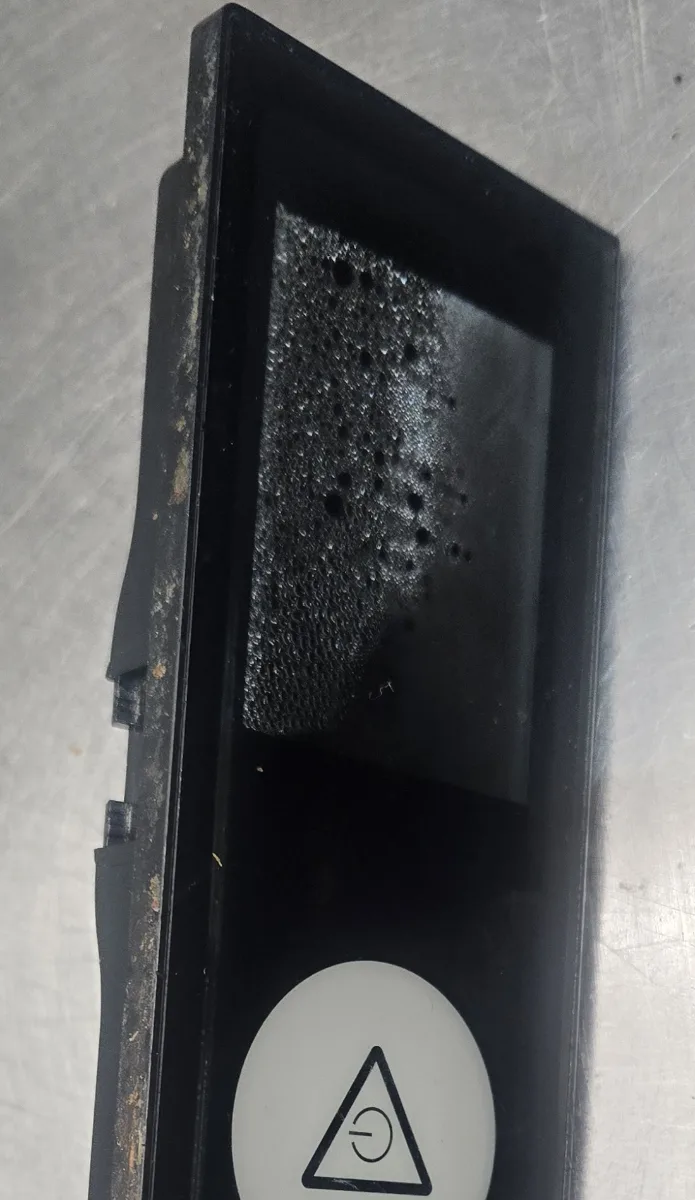
Moisture behind the display. On a Hobart undercounter dishwasher, droplets of water had got behind the screen cover into the display. Read the Hobart display moisture case and Hobart dishwasher error codes.
Hobart dishwasher control panel fascia removed, with water droplets inside the display window

Commercial refrigeration repair

A commercial refrigeration unit had lost its refrigerant through a leaking evaporator. We fitted a new evaporator and leak-tested the system, and then found the compressor had failed as well, so the unit could not run until a new compressor was fitted. A refrigerant leak left too long takes the compressor with it. See our commercial refrigeration repair page.

Why regular service is the key

Almost every case above began with water, scale or dirt that a regular service would have caught: a water filter not changed, a wash system not cleaned, a machine descaled the wrong way. Every repair we do starts with checking and cleaning, and very often the equipment works again after the service alone. For planned maintenance, see catering equipment maintenance and restaurant equipment maintenance.

Book a commercial kitchen equipment repair in London

LE Company’s call-out is from £175 + VAT and includes the first 30 minutes on site, when the engineer finds the cause of the fault. The cost of the repair is agreed with you before any work starts. Our engineers are Gas Safe registered. For a breakdown during service, see emergency restaurant equipment repair, or call +44 203 603 7172.

Gaggenau vs Miele: an engineer’s comparison


Gaggenau and Miele are both premium German brands, and both make a top line and a lower line. LE Company engineers repair both in London, and from what we see inside them: if you plan to spend between £1,000 and £2,000 on an appliance, at 2025–2026 prices, there is no real difference between the two. In premium fridges Gaggenau is ahead: it moves cold air better and uses less energy. In dishwashers the washing quality is practically the same. In ovens both are at the top, but recently SMEG has overtaken them. For repairs, see our Gaggenau repair and Miele repair pages.

Gaggenau vs Miele fridge

With both brands, look at how the fridge is cooled, not at the badge. If you buy a fridge where only the back panel is cooled and a fan stirs the air, do not expect a good flow of cold air inside. You can open it four or five times a day. Open it more often and the air temperature rises, on average to around 9–11°C. The food already inside is not harmed, because it holds its own temperature. But new food you put in will only be properly cold the next morning, and you will not get that feeling of cold air meeting you when you open the door. That you only get with top-class fridges. We explain the difference in detail in are expensive fridges worth it.
In the premium models, Gaggenau is ahead. Its whole system is built to move the air: the air is driven through the cooling panels, through the evaporator inside them, and back into the compartment. For low energy use we would also put Gaggenau first. Its one weak point is a condenser that needs cleaning, as in this Gaggenau freezer that was alarming and not freezing. See our Gaggenau fridge repair page, and our Liebherr vs Gaggenau fridge comparison.
Gaggenau freezer condenser after cleaning by LE Company

Gaggenau vs Miele oven, and why SMEG has overtaken both

In ovens, both Gaggenau and Miele hold top positions. Recently, though, SMEG has overtaken them. Its Galileo Omnichef combines three ovens in one: a microwave, a steam oven and a conventional oven.
Its handling of water is excellent. There is practically no water left in the system: when you finish cooking, the oven makes you empty it. That is why you will practically never get a leak. We tested it hard for five years, expecting something to break. In all that time we replaced only one conventional heating element, and that happens on every make of oven.
SMEG’s build quality is very high, and we would put it at the very top. Every joint is fitted with a gasket, which we do not see on any other make. You will practically never hear a rattle, a vibration or a scrape, and opening and closing the door is a pleasure in itself. Even the smaller, compact model has an inside that looks practically no different from a full-size Gaggenau or Miele. See why a Smeg oven stops working, our SMEG oven repair and Gaggenau oven repair pages, and why Miele ovens are built to last.

Gaggenau vs Miele dishwasher

Here the quality is the same, and the leak protection is the same. Washing quality is practically identical. Choose by what you like: in the new models, look at the functions and how convenient they are to use. If your Miele shows a code, see Miele error codes. See our Miele dishwasher repair page and what to do when a Gaggenau dishwasher is not draining.

Who makes Gaggenau and Miele?

Miele is a family-owned company, owned by the Miele and Zinkann families. Its ovens are made in Oelde, its steam ovens and hobs in Bünde and its dishwashers in Bielefeld, all in Germany. Gaggenau has been part of BSH, the Bosch home appliance group, since 1995. It names factories in Germany, France, Slovenia, Spain and Turkey; the built-in Gaggenau fridge we repaired in November was labelled made in Turkey.

Warranty and spare parts

Miele gives a standard 2-year manufacturer’s guarantee on its domestic appliances in the UK, with longer cover in promotions or as a paid extension. Gaggenau’s UK terms extend its 2-year warranty by a further 3 years, to 5 in total; check the conditions when you register the appliance. Both brands say spare parts are available for up to 15 years after a model goes out of production. “Up to” matters: in October we met a Gaggenau wine fridge whose control board had already been discontinued.

Is Miele really tested for 20 years?

Miele tests some appliances to simulate 20 years of average household use, for example 5,600 cycles for dishwashers and 2,160 hours for ovens and steam ovens. Miele itself says this is not a guarantee of durability, and its list does not include fridges, coffee machines or hobs.

Gaggenau or Miele: which should you buy?

For a fridge in the £1,000–2,000 range, either; check how it is cooled. For a premium fridge, Gaggenau, for the air flow and the low energy use. For a dishwasher, whichever functions you like. For an oven, look at SMEG as well as Gaggenau and Miele. If you are comparing range cookers, see our Lacanche vs La Cornue comparison.

Book a Gaggenau or Miele repair in London

LE Company’s call-out is from £175 + VAT and includes the first 30 minutes on site, when the engineer finds the cause of the fault. The cost of the repair is agreed with you before any work starts. Call +44 203 603 7172, or see our frequently asked questions.
Hobart dishwasher display not working: water behind the screen


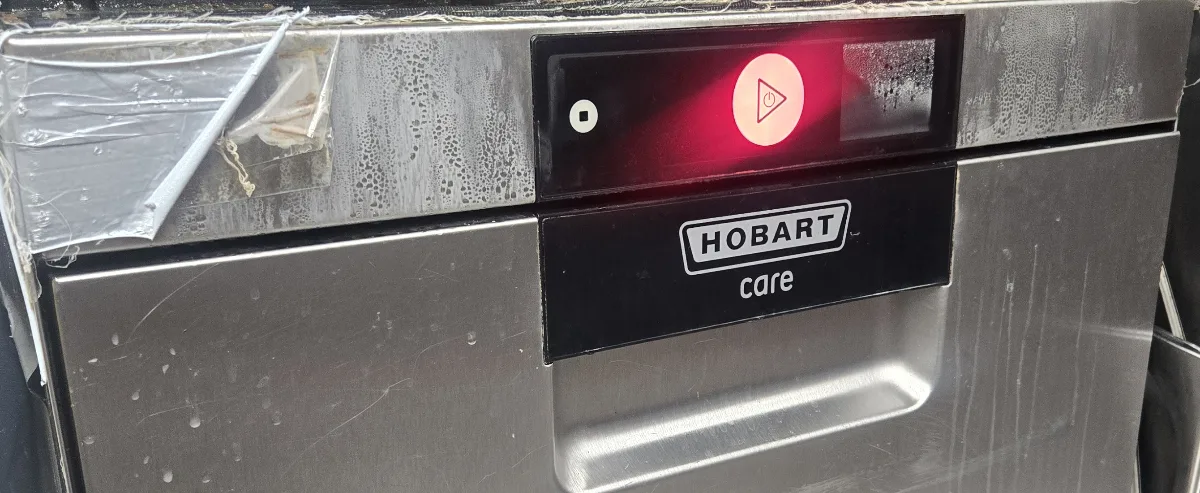
When the display of a Hobart dishwasher stops working or becomes unreadable, the cause can be water inside the display itself. That is what LE Company engineers found today in a restaurant in Central London, on a Hobart CARE undercounter dishwasher (model CARES-10B). The kitchen team could see droplets trapped behind the screen cover. Here is what we found and what it means. For our full Hobart service, see Hobart dishwasher repair in London.

Why is my Hobart dishwasher display not working?

The customer called us because moisture droplets were visible behind the screen cover of the control panel. On arrival we could see it straight away: the display window at the right of the panel was misted with water from the inside.
Hobart CARE undercounter dishwasher with water droplets inside the display window of the control panel

What we found behind the screen cover

We removed the control panel fascia, the part that carries the screen cover and the display window, and inspected it. Water droplets were present in the display window, behind the screen cover: moisture had got into the display of the control panel. We then checked the display screen itself. It had failed.
Hobart dishwasher control panel fascia removed, with water droplets inside the display window
The conclusion is simple: the display screen of the control panel needs to be replaced. On this Hobart CARE model the display cannot be repaired: it is replaced as a complete unit. We recommended doing it as a matter of urgency, and testing the machine after the new screen is fitted.

Can a Hobart dishwasher display dry out by itself?

Do not count on it. Once water has reached the electronics behind the screen cover, the damage is often done even if the droplets later dry, and on this machine the screen had already failed. A display that is misted, flickering or blank needs to be checked by an engineer rather than left to see whether it clears. On the Hobart CARE the display is not repaired, only replaced.

Keeping the machine clean helps

We also recommended a thorough clean of the machine, with the dishwasher pulled out so that the engineer can reach all of it. Commercial dishwashers work in steam and water all day, and a machine that is kept clean is easier to inspect and less likely to hide a developing fault. For routine care and the codes the machine shows, see our guide to Hobart dishwasher error codes and the top reasons commercial dishwashers break down. We can also look after your machines on a planned schedule: see commercial catering equipment maintenance.

Book a Hobart dishwasher repair in London

LE Company’s call-out is from £175 + VAT and includes the first 30 minutes on site, when the engineer finds the cause of the fault. The cost of the repair is agreed with you before any work starts. We repair Hobart catering equipment, Winterhalter dishwashers and other makes; see our commercial dishwasher repair page or call +44 203 603 7172. Prices and parts are covered in our frequently asked questions.

Hobart dishwasher error codes: what they mean and what to do


The same Hobart error number can mean different things on different machines, so start by finding which range yours belongs to. Hobart Ecomax dishwashers and glasswashers show Er with a two-digit code, Profi and Premax machines show a three-digit code such as 021 or 033, and older AM900 hood machines show F01 to F04. This guide from LE Company, commercial dishwasher engineers in London, lists the codes from Hobart’s own operating instructions, what you can check yourself and when to call an engineer. For repairs, see our Hobart dishwasher repair page.

How to tell which Hobart you have

Ecomax (for example the 404, 504, G404, F504, Ecomax+ 415 / 515 and the H604, H614 and H615 hood machines): Er appears on the top display with a two-digit code underneath, and the On/Off button lights red. Notices use letters: SA Lt, Door or Hood, and HY.
Profi and Premax (Profi FX, GX and GC, Premax FP, GP and GCP, Profi AMX / AMXX hoods and Premax AUP): three-digit codes from 001 to 071, in two classes. An information message makes the button flash green and red; the machine still works and you acknowledge it with the tick. A fault keeps the button red, and the machine switches off when you acknowledge it.
Ecomax Plus C815 rack conveyor: Er01 to Er29, with meanings different from the hood and undercounter machines. AM900 (older hood): F01 to F04 and letter codes.

Hobart Ecomax error codes

Ecomax code
Meaning
What Hobart tells you to do
Er 01 / 02
Boiler temperature sensor reading too high / too low
Call service
Er 03
Boiler thermostop during the wash programme
Call service
Er 05 / 06
Tank temperature sensor reading too high / too low
Call service
Er 07 / 08
Boiler pressure sensor reading too high / too low
Call service
Er 09 / 10
Tank pressure sensor reading too high / too low
Call service
Er 12
Water level regulation in the wash tank failed
Call service
Er 13
Filling not completed (tank pressure sensor)
Drain the machine
Er 14
Wash tank did not drain in the pump-out programme
Clean the drain hose and pump out again
Er 17
Filling monitoring by impeller sensor
Check the water supply
Er 18
Filling monitoring by boiler water level
Check the water supply
Er 28
Wash tank level too low at programme start
Refills automatically; if it stays, call service
Er 29
External water treatment cartridge used up
Replace the cartridge
Er 31
Filling monitoring
Check the water supply, then call service
SA Lt
Salt for the built-in softener has run out
Top up with granular regenerating salt
HY
Hygiene programme due
Run the HY programme with hygiene tabs
Door / Hood
Door or hood open
Close it

Hobart Profi and Premax error codes

Profi / Premax code
Meaning
What Hobart tells you to do
001 / 002, 006 / 007, 011 / 012
Temperature sensor fault: boiler, wash tank or wash chamber
Call service
003, 004, 008, 009
Temperature not reached (information)
Call service
013
Disinfection not guaranteed
Call service
014 to 017
Pressure sensor fault: boiler or wash tank
Call service
018
Water level regulation in the wash tank
Acknowledge; the machine pumps out automatically
020
Wash tank pressure sensor fault
Pump out the machine and restart
021 / 022
Fault in the drain system (information)
Clean the drain hose and pump out again
029 / 039
Programme or filling programme stopped
Close the door or hood
031 / 032
Water supply
Check that the water tap is open
033
Fault in the filling system
Call service
034
Service interval due
Call service
035
Tank cover strainer not fitted correctly
Refit the strainer
036 / 037
Detergent / rinse aid low
Refill
038
Mains voltage too high: machine switched off
Have an electrician check the supply
040
Hygiene programme due
Run the hygiene programme
041 / 042
Water treatment cartridge / osmosis pre-filter used up
Replace it
043 / 044
Salt low (information) / salt empty (fault)
Refill regenerating salt
045
Too many rinses without regenerating salt
Call service
052
Fault in the filling or drain system
Disconnect water and power, call service
060 to 069
Osmosis system or drying function fault
Call service
070 / 071
Wash / rinse temperature too low
Call service

What does Hobart error code 033 mean?

On Hobart Profi and Premax dishwashers and glasswashers, 033 is a fault in the filling system. The machine switches off when you acknowledge it, and Hobart's instructions say to contact service. Check first that the water tap is open; 031 and 032 are the codes that ask you to check the water supply. A filling fault often comes back to the site supply: the water pressure, a partly closed valve or a blocked inlet strainer. If the supply is fine, the inlet valve, the pressure sensor or the controls need testing.

What does Hobart error code 020 or 021 mean?

On Profi and Premax machines, 020 is a wash tank pressure sensor fault: pump out the machine and restart it. 021 is a fault in the drain system: clean the drain hose if necessary and pump out again; on hood machines, hold the On/Off button for 3 seconds to restart the pump-out. If either code comes back, call service. A drain fault that keeps returning usually means a blocked or kinked drain hose, a blocked drain on site or a failing drain pump. See why a dishwasher is not draining.

What do Hobart error codes 07, 08, 17 and 18 mean?

This is where most confusion comes from. The same number means different things on different Hobart ranges:
Number
Ecomax
Profi / Premax
Ecomax Plus C815 conveyor
07
Boiler pressure sensor too high
Temperature sensor fault
Door or cover open
17
Not filling (impeller sensor)
Pressure sensor fault
Emergency stop pressed
18
Not filling (boiler level)
Wash tank water level
Display communication error
21
Filling stopped (2017 models)
Drain fault
Boiler temperature sensor
So always give the engineer the full model name from the rating plate together with the code.

What does HY mean on a Hobart dishwasher?

On Hobart Ecomax machines HY means the hygiene programme is due. Put in the HOBART hygiene tabs (2, or 1 on the Ecomax 404), select programme HY and close the door; it runs for about 10 minutes, drains and switches off. On Profi and Premax machines the same reminder is code 040. If the display itself is misted, blank or unreadable, see our case of a Hobart dishwasher display not working because of water behind the screen.

Hobart salt and water softener messages

SA Lt means the salt for the built-in water softener has run out. Top up with about 1 kg of granular regenerating salt (2 to 8 mm grains), never salt tablets; the message clears a few minutes later. Never put detergent in the salt container, because it damages the softener. Salt spilled on the tank floor causes corrosion: wipe it out and run a wash programme. On Profi and Premax machines, 043 means the salt is low, 044 that it has run out, and 045 that too many rinses have run without salt, which needs service. Hobart recommends water of 0 to 3 °dH total hardness, and London water is hard, so a working softener matters.
The Ecomax and Profi instructions we checked do not include a descaling programme. Where rinse nozzles are clogged, usually by lime, Hobart says to remove the rinse arms, descale them in a separate container and check the softener. A fine strainer blocked by lime can be soaked in a vinegar solution and brushed; clean it daily.

Does Hobart use error codes F03, F04, E2 or E5?

F01 to F04 appear on the older Hobart AM900 hood dishwasher, where F03 is a rinse booster pressure transmitter fault and F04 a tank pressure transmitter fault; both need service. E-codes such as E2 and E5 belong to Hobart's US machines (for example the LXi, where E5 means will not drain), not to the Ecomax, Profi or Premax machines sold in the UK. We could not confirm an AL code on any current UK Hobart model, so if your machine shows AL, send us a photo of the display and the rating plate.

When to call a Hobart engineer

Call an engineer for any fault that tells you to contact service, if a code returns after you have checked the water tap, the drain hose and the strainers, or if the machine is not reaching temperature (070, 071) or shows that disinfection is not guaranteed (013). For other makes, see our guide to Winterhalter error codes. Planned servicing prevents many of these faults: see commercial catering equipment maintenance.

Book a Hobart repair in London

LE Company’s call-out is from £175 + VAT and includes the first 30 minutes on site, when the engineer reads the codes and finds the cause. The cost of the repair is agreed with you before any work starts. See our Hobart dishwasher repair, Hobart repair in London and commercial dishwasher repair pages, read our frequently asked questions, or call +44 20 3603 7172, Monday to Saturday, 8am to 8pm.

Winterhalter error codes: what they mean and what to do


Most Winterhalter error codes point to one of five things: water supply (Err13, Err14), drainage and filters (Err6, Err24, Err25), heating (Err7, Err8), the hood (Err21) or a leak into the base (Err35). This guide from LE Company, commercial dishwasher engineers in London, explains what each code means on the Winterhalter PT pass-through range and on older GS glasswashers, what you can check yourself, and when to call an engineer. For repairs, see our Winterhalter dishwasher repair in London page.

How a Winterhalter shows an error code

Current UC undercounter machines (touchscreen): most problems appear as pictograms and you can keep washing. A serious error stops the machine, a red bar appears across the top of the display and the start button turns red; tap the bar to see the code. The Errors menu lists current and rectified errors.
PT pass-through machines and earlier UC machines (blue display): a pictogram flashes, and the error memory lists entries as ERR 35 (fault), ERR 35 OK (fault cleared) and ON, newest first.
Older GS glasswashers: Err and a number appear on the control panel with a fault lamp.
For every numbered error, Winterhalter’s operating instructions tell owners the same thing: note the code and call an authorised service technician. The tables below tell you what the code means, so you know what to check first and what to tell the engineer.

Winterhalter PT error code list

These meanings are taken from Winterhalter’s technical card for the PT-M, PT-L and PT-XL pass-through (hood-type) dishwashers. UC and UF machines of the same generation show codes the same way, but some numbers can differ, so tell the engineer your model.
Code
What it means (PT-M / PT-L / PT-XL)
What the machine does
Err1
Tank level sensor: short circuit, cable or plug fault
Tank drained, machine off
Err2 / Err3
Tank / boiler temperature sensor fault
Tank / boiler heating off
Err4
Wash pump or tank level sensor fault: tank level not dropping
Wash pump drive off
Err5
Final rinse pump or boiler level sensor fault, or rinse jets blocked
Final rinse pump off
Err6
Drain pump not working: tank level not dropping within 3 minutes
Machine off
Err7
Boiler heating or power unit fault: boiler not heating up
Boiler stays cold, machine still works
Err8
Tank heating or power unit fault: tank not heating up within 15 minutes
Tank heating off
Err9
Drain pump not working: self-cleaning programme cannot finish
Machine off
Err10
Salt container empty (built-in softener) or water treatment cartridge expired
Message on display
Err11 to Err12.1
Wash pump frequency converter overheated or faulty, or its bus cable faulty
Converter or machine off
Err13
Tank filling time exceeded: water tap closed, inlet filter or valve blocked, or a leak
Check water supply
Err14
Boiler filling time exceeded: water tap closed, inlet filter or valve blocked
Check water supply
Err15
Boiler level sensor fault: tank level rising when the boiler should be empty
Boiler heating and inlet valve off
Err16 / Err17
Rinse aid / detergent container empty
Dosing stops after 20 more cycles
Err18.1
Hood sensor fault: the hood must be opened at least once every 20 cycles
Wash pump drive off
Err21
Hood opened while a programme was starting or a wash was running
All functions stop
Err22
Service interval expired
Message on display
Err23
Mains voltage failure
Machine off
Err24
Tank level too high: drain on site blocked or drain pump faulty
Rinse and inlet off, drain pump runs
Err25
Filter cylinder blocked: tank level too low during washing
Tank heating off until the hood is opened
Err26
Tank level rising while the machine is switched off
Drain pump runs
Err28 / Err29
Top / bottom wash arm blocked, not turning properly
Err30
Tank water medium to heavily cloudy
More final rinse water used
Err31
Bottom wash arm not fitted properly; boiler level rising during washing
Wash stops, final rinse pump runs
Err33
Descaling interval expired
Message on display
Err34
Tank not watertight: level dropping with the hood closed
Inlet valve off
Err35
Water in the base frame: leakage sensor triggered
Inlet valve, rinse and wash pumps off
Err36 / Err37
Top / bottom wash arm drive faulty
Drive off after 3 repeats
Err40
Boiler level sensor: short circuit, cable or plug fault
Machine off
Err DIN
Tank or boiler temperature too low for the hygiene standard
Err48 / Err49
Pump inlet filter not fitted
Machine stops after 30 seconds without the filter
Err52
Site power supply does not match the machine’s set supply type
Machine off
Err54
Automatic hood opening faulty
Machine off
Err59 / Err60
Power unit relay faulty or overheated: boiler / tank heating stuck on
Boiler or tank drained

What does error 35 mean on a Winterhalter dishwasher?

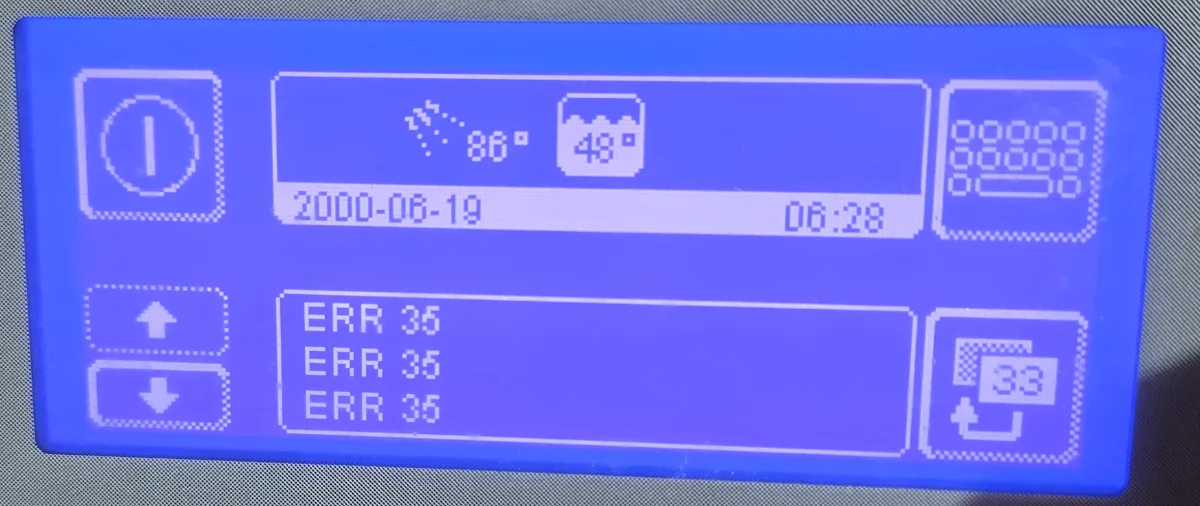
Err35 means water has reached the base frame and triggered the leakage sensor (marked I6 on the PT-M wiring diagram). The machine shuts off the water inlet and the wash and rinse pumps to stop the leak getting worse. The water can come from a hose, a pump seal, the tank or, as in our case, from water being forced backwards out of a connection.
Winterhalter PT-M display showing ERR 35 three times, leakage sensor triggered
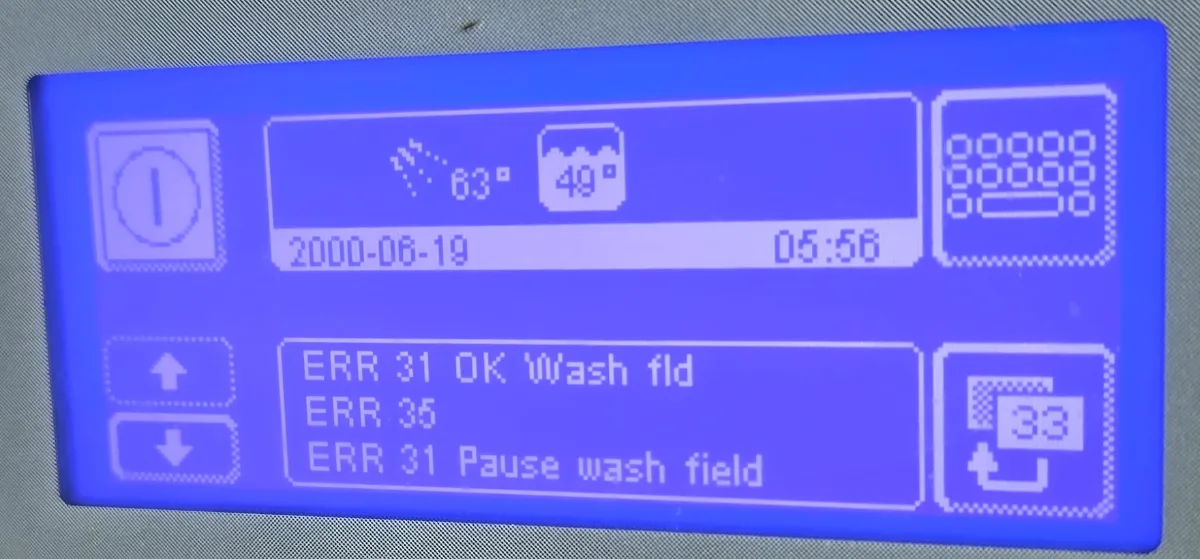
In October 2026 a London restaurant called us about error 35 on its Winterhalter PT-M. We read the error log, checked the wiring diagram, where the leakage sensor that raises Err35 is marked I6, removed the lower panel and found water running into the base tray from the wash-system inlet at the back of the machine. The main wash system was so heavily blocked that the wash pump built up pressure and pushed water back out of the inlet. We cleaned the wash system and removed the upper wash arm, which was blocked beyond cleaning, for replacement. The log also showed Err31 entries, which on the PT series relate to the lower wash arm.
Winterhalter PT-M error log showing ERR 31 and ERR 35 entries
The lesson: clean the wash arms, filters and wash system as the operating instructions say. A blocked wash system can cause a leak, not only poor results.

Winterhalter error 21 and 23: hood and power

On the PT series, Err21 means the hood was opened while a programme was starting or a wash cycle was running; the machine switches off all its actuators. Close the hood and start again. On older GS 202 / GS 302 glasswashers Err 21 relates to the water level or the inlet valve: close the water tap and call service. On the PT series, Err23 means a mains voltage failure, and the machine switches off. Check the supply to the machine; if the code returns with the power on, the machine needs an engineer.

Winterhalter error 13, 14 and 6: water in and water out

Err13 and Err14 mean the tank or the boiler took too long to fill. Check that the water tap is fully open and that the inlet filter is not blocked; if both are fine, the inlet valve or the rinse pump may be faulty. Err6 and Err9 mean the drain pump is not getting the water out, and Err24 means the tank level stayed too high because the drain on site is blocked or the drain pump is faulty. For drainage problems in general, see why a dishwasher is not draining.

Winterhalter error 8 and 7: tank and boiler not heating

Err8 means the wash tank did not heat up within 15 minutes, and the tank heating is switched off. Err7 means the boiler did not heat up; the machine can still run, but the rinse water stays cold. Both point to the heating element or the power unit, and both need an engineer. Err DIN means the tank or boiler temperature is too low to meet the hygiene standard.

Winterhalter error 25, 48 and 49: filters

Err25 means the filter cylinder is blocked, so the tank level drops too low while washing. Err48 and Err49 mean the pump inlet filter is not fitted: after 30 seconds without the filter the machine switches off. Clean the filters and refit them properly; if the code returns with clean filters in place, call an engineer.

What does error 33 mean on a Winterhalter?

Err33 is a reminder, not a fault: the descaling interval set on the machine has run out. London water is hard, and scale in the boiler, tank and pipework is one of the main causes of poor results and failed heaters on Winterhalter machines.
Winterhalter’s instructions for its UC machines say to use an acid-based descaler suitable for commercial warewashers (Winterhalter recommends its A 70 LS) with the menu-guided descaling programme, ideally at the end of the day. Never mix descaler with chlorine detergent, because it releases chlorine gas: switch off or disconnect any external detergent pump first. Do not cancel the programme, and do not leave descaler in the machine overnight. The water lines and the boiler can only be descaled by an authorised technician.
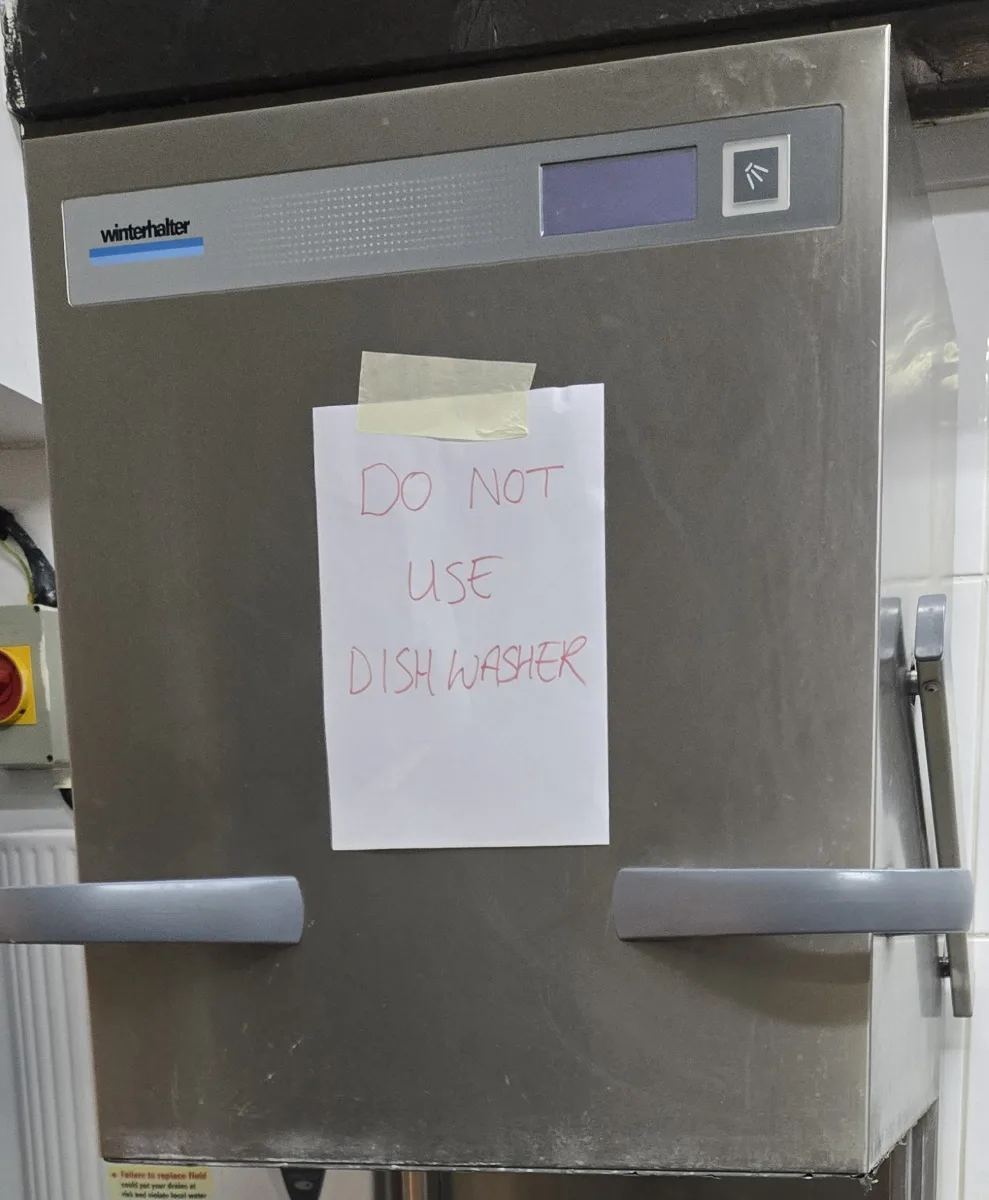
Winterhalter PT-M dishwasher taken out of use after an incorrect descale
What happens when it goes wrong: in October 2026 we were called to a Winterhalter PT-M in a London kitchen that would not drain. The owner had tried to descale it with too little descaler. The residue had turned to sludge and blocked the whole waste pipe and the drain pump, and several pipes had ruptured. We cleaned the drain and pump by hand, then returned to fit new hoses, a boiler kit and 15 mm flexible pipework, and descaled the machine properly. Our advice to that kitchen, and to yours: do not descale without an engineer if you are not sure of the procedure.

Winterhalter error 40

On the PT series, Err40 means a fault on the boiler level sensor: a short circuit, a damaged cable or a plug that is not connected properly. The machine switches off. It is not something an owner can fix; an engineer has to test the sensor and its wiring.

Older Winterhalter GS glasswasher error codes

Older GS 202 / 215 and GS 302 / 315 glasswashers use a shorter list, and the numbers do not mean the same as on the PT series. Winterhalter’s instructions for these models are: switch the machine off; for Err 20 close the water tap and call service; for other codes check that the water tap is open and switch on again; if the code comes back, note it and call service. A flashing blue programme button means the filters are blocked: switch off, clean the filters and switch on again after 2 minutes.
Code
GS 202 / 215 and GS 302 / 315 glasswashers
What Winterhalter tells you to do
Err 1
Fault inside the machine; it switches off
Call service
Err 2 / 3
Boiler or tank above 95 °C (GS 202 / 215)
Switch off at the mains isolator and call service
Err 6
Internal fault or blocked drain
Clear the drain or call service
Err 20
Water inlet (solenoid) valve not closing
Close the water tap and call service
Err 21
Water level too high or inlet valve not closing
Close the water tap and call service

What about Winterhalter error 202, 305 or 501?

Three-digit numbers such as 202, 305 and 501 are not in Winterhalter’s published code lists that we have checked, so we will not guess what they mean. If your machine shows one, take a photo of the display and the rating plate and send it to us with your enquiry: our engineers read the full error log on site.

When to call a Winterhalter engineer

Call an engineer if a code returns after you have checked the water tap, the filters and the drain, if water is leaking (Err35), if the machine is not heating (Err7, Err8) or if a sensor or power fault is shown. Regular cleaning and planned servicing prevent most of these codes; see commercial catering equipment maintenance and the top reasons commercial dishwashers break down.

Book a Winterhalter repair in London

LE Company’s call-out is from £175 + VAT and includes the first 30 minutes on site, when the engineer reads the error log and finds the cause. The cost of the repair is agreed with you before any work starts. See our Winterhalter dishwasher repair and commercial dishwasher repair pages, we also repair Hobart dishwashers, read our frequently asked questions, or call +44 20 3603 7172, Monday to Saturday, 8am to 8pm.

How to prepare your appliances for Christmas by LE Company


When you choose LE Company, there are just two simple steps you need to follow to prepare your appliances for Christmas. First, arrange pre-Christmas maintenance visits in advance. Second, arrange maintenance for the most crucial appliances at least.

Arrange pre-Christmas maintenance visits in advance

At LE Company, we always advise our customers to start preparing their appliances for Christmas in advance. Here are a few reasons why we recommend not putting off preparation until the last few days before Christmas:
  • Late bookings risk there being no slot available
  • A part ordered in late December may not arrive until January

To clarify, December is the busiest period for electrical engineers in London. Sometimes, we even have to stop taking new bookings by mid-December. So, if you send us your service request just a week before Christmas, we simply may not have a slot to schedule our visit to your home. Besides, over the holidays, parts are rarely held in stock and the delivery time may increase drastically as suppliers shut down or run reduced hours.

Arrange maintenance for at least the most crucial appliances

At LE Company, we recommend arranging pre-Christmas maintenance at least for ovens, fridges, and dishwashers. If you have other appliances you rely on over Christmas, mention them when booking, and we will include them in the visit. We check every component that typically fails under extra load, so you can rest assured your Christmas will not be ruined by a breakdown.

Ovens

Our pre-Christmas oven preparation visits typically cover:
  • Electrical safety check – to ensure the plug, cable, and circuit will withstand the increased load
  • Door seal inspection – and replacement if the gasket is split, hardened, or no longer magnetic
  • Fan motor test – checking for grinding or slow rotation, replacing the motor or blades if necessary
  • Grill element inspection and testing – cleaning or replacing the element if corroded
  • Thermostat check – verification the temperature against a calibrated thermometer, adjustment or replacement, if necessary

Fridges

To prepare your fridge for Christmas, our maintenance visits typically cover:
  • Electrical safety check – to ensure the plug, cable, and circuit will withstand the increased load
  • Condenser coil cleaning – vacuuming or brushing the coils to restore cooling efficiency
  • Temperature verification – running a thermostat check against a calibrated thermometer
  • Door and seal inspection – to ensure the door closes and seals correctly
  • Defrost drain check and cleaning – to prevent water pooling

Dishwashers

For dishwashers, our pre-Christmas maintenance visits typically cover:
  • Electrical safety check – to ensure the plug, cable, and circuit will withstand the increased load
  • Filter clean and drain check – to clear the filter and ensure the pump drains freely
  • Inlet and drain hose inspection – and replacement if the hose is cracked
  • Door seal inspection – and replacement if necessary
  • Door interlock test – to ensure the machine starts, locks, and completes a cycle successfully

Conclusion before Christmas

So, to be sure your appliances will withstand the increased load they have at Christmas, requesting a maintenance visit in November or at least early December is a wise idea. When arranging pre-Christmas maintenance, focus on at least your core appliances – cooking, refrigeration, and dishwashing.
Home › Gaggenau Repairs › Gaggenau Dishwasher Not Draining

Gaggenau Dishwasher Not Draining


In short, a Gaggenau dishwasher not draining may typically result from two main causes – clogs and blockages or mechanical failures.

Clogs and blockages

Typically, clogs and blockages may be caused by food debris, grease, or glass fragments. While you can easily address some blockages yourself, other issues may require professional Gaggenau dishwasher repair.

Clogs and blockages you can address yourself

At LE Company, we build the list of issues to check first if your Gaggenau dishwasher is not draining:
  • Clogged filters (at the bottom of the tub)
  • Clogged drain pump impeller (underneath the filter)

To troubleshoot the clogged filter, pull out the filter and wash it with warm soapy water. To troubleshoot the clogged drain pump impeller, reach in with tweezers to pull out blocking glass fragments or food debris.

Clogs and blockages to turn to professional service

Apart from a clogged filter or drain pump impeller, there could be more severe issues for a Gaggenau dishwasher is not draining:
  • Clogged check valve (the valve that prevents backflow)
  • Clogged drain hose (the hose connected with the sink drain or garbage disposal)
  • Clogged or jammed drain valve (the valve that opens to release water)

Typically, at LE Company, it takes us 15 – 30 minutes to troubleshoot the clogged drain hose and 20 – 40 minutes to troubleshoot an issue with the check valve. A clogged or jammed drain valve requires more extensive disassembly. Typically, it takes us 1 – 1.5 hours to fix this issue.

Mechanical failures

Mechanical failures are the most severe issues. Addressing such failures is not a DIY task but requires professional assistance.

At LE Company, we build a list of common mechanical failures that lead to drainage problems:
  • Broken drain impeller (can’t physically push water out of the dishwasher)
  • Burned pump motor (drain pump not working at all)
  • Faulty control board (can’t send power to the drain pump)
  • Faulty drain solenoid (can’t open the drain valve)

Typically, in all these cases, the component needs replacement. Fortunately, with the component in stock, our engineer can fix any of these issues just in one go.

Conclusion

To summarise, a Gaggenau dishwasher not draining is typically caused by either clogs and blockages or mechanical failures.

Minor issues, such as a dirty filter or a blocked drain pump impeller, can often be resolved with simple DIY cleaning. A clogged drain hose, check valve, or drain valve are more complicated problems and require professional attention. The most serious cases involve mechanical component failures (a broken impeller, burned-out motor, faulty control board, or defective solenoid) and almost always demand part replacement by a qualified technician.

If you need our help, we are always at your service. Visit our contact page.
Home › Commercial Dishwasher Repair › Why Your Dishwasher Isn’t Draining and What You Can Do

Why Your Dishwasher Isn’t Draining and What You Can Do


If after the dishwashing cycle you detect water left inside, you have got a classic dishwasher not draining problem.

To tell the truth, this is, perhaps one of the most common dishwasher problems. For example, when we get a request for Miele dishwasher repair in London, in half of the cases it is a problem we discuss here.
The good news is that most such issues you can fix even without any complicated dishwasher repair tips.

But let’s discuss this in detail.

Quick Symptoms & Safety Checks

Before contacting a repair company, whether it is for domestic dishwasher repair or commercial dishwasher repair, we recommend a quick assessment and safety checks.

Quick Symptoms: Standing water vs. slow drain

When you detect water in the dishwashing tub, evaluate its amount. It may give you a quick key to what’s happened to your appliance.

Typically, there can be two cases:
  • Water standing to an inch or more – pump failure or control board issues
  • Just a small puddle –clogged filter or drain hose

Safety Checks: Switch off power and water

If it is a clog, you can tackle the issue without any preparation. In all the other cases, you need to prepare your appliance for the necessary procedures.

For this, first, turn off the water supply valve to ensure no water input. Second, unplug the unit from the socket to de-energise it to make it fully safe and ready for further fixes.

Most Common Causes

Now, let’s dive deeper into the common dishwasher problems that cause the issue. For example, when we get a request for Hobart dishwasher repair with complaints about poor draining, it is typically one of the following three causes.

Clogged filter or sump

This is where the problem arises first.

The filter task is to prevent food debris from getting inside the system. Over time, the filter becomes clogged and stops letting water drain out of the machine.

If some very fine particles escape the filter, they get into the sump. For example, on one of our last SIEMENS dishwasher service call-outs, we detected a critical sludge at the bottom of the sump. Over time, the sump may accumulate a large amount of such particles. In turn, such a clog results in preventing water from flowing out.

Blocked/kinked drain hose or air gap

This is the second issue that leads to poor draining.

Typically, a clog in these components results from oils, fats, and fine powder-like particles that get into the system. For example, after cooling, oils and fats turn into sludge that envelop the inner side of the hose and get accumulated in the gap. So, the problem may occur even with a clean filter.
When the clog becomes critical, water will not find enough space to go through, and issues with draining arise.

Faulty drain pump or impeller

This is a serious problem. For example, a few of our Bosch dishwasher repair call-outs were about a malfunctioning drain pump or a jammed impeller and it took time to repair without replacing. 

To clarify, water gets out of the dishwasher not because of gravity but due to the efforts of the drain pump. Over time, it can fail and stop working, which leads to the dishwasher not draining.

To go further, the drain pump consists of the impeller, a fan-like part that physically moves the water. If a toothpick or glass pieces slip through the filter and get into the system, they may jam the impeller, which stops its running.


Step-by-Step DIY Checks

Here are some dishwasher repair tips to follow when your dishwasher is not draining.

Clean the filter & sump

It is the easiest task. Just follow the steps:
  1. Locate the filter, the cylindrical item with a flat mesh piece
  2. Twist the filter left and remove it
  3. Put the parts in water and clean with a soft brush to remove sludge
  4. Wipe out the sump and get rid of the sludge there
  5. Place the filter back in its location and twist right to reassemble
DIY dishwasher cleaning steps illustration

Inspect and flush the drain hose

This is a more complicated task. So, to do it yourself, you need some basic knowledge of dishwasher installation and de-installation. To clarify, the drain hose is located on the side or back of the dishwasher. Therefore, to deal with it, you need access to this side or back. In other words, you need to pull your appliance from under the counter. If you aren’t sure you can do this, turn to professionals.
The DIY steps are as follows:
  1. Unplug your dishwasher to de-energise it
  2. Access the appliance side or back
  3. Locate the drain hose
  4. Check it at its entire length for kinks
  5. Arrange a pallet and sufficient cleaning cloth to deal with residual water
  6. Disconnect the hose (at its both sides)
  7. Flush the hose to get rid of blockages
  8. Connect the hose back as it was
  9. Plug in the appliance

Run a rinse/drain cycle & check error codes

If you detect a significant amount of water, do a quick DIY check that may help you identify the issue.

Run a quick washing cycle or drain-only cycle if your model has one. Listen carefully to the coming sounds:
  • A humming sound – the impeller is jammed or the pump has failed
  • No sound at all – the pump isn't getting power or is completely dead

In any of these cases, we recommend turning to an engineer and describing the signs you detected. If your dishwasher flashes with an error code, remember the code and inform your engineer about it. For commercial machines, our guides to Hobart dishwasher error codes and Winterhalter error codes explain what each code means.

When to Call an Engineer

Unless you are a professional engineer fully familiar with the dishwasher’s engineering in general and your model one in particular, your only DIY options include troubleshooting minor clogging and checking for error codes. For all other cases, it is recommended to turn to a professional.
In short, the cases when to call an engineer, cover:
  • Deep and severe clogging
  • Professional drain hose flushing
  • Any pump failures
  • Control board failure

Burning smell, tripped breaker, repeated errors

If you are facing repeated errors even after cleaning the filter and flushing the hose, it means the issue is somewhere else, and you need a professional to detect and fix it.

Burning smells or a tripped breaker is one of the most dangerous issues for your safety:
  • A burning smell indicates a serious electrical fault
  • The tripped breaker indicates a short circuit in the pump or wiring

So, if you notice them, stop using the dishwasher and contact an engineer without delay.

Prevention & Maintenance Checklist

While there are many causes for a dishwasher not draining, you can prevent most of them. Here is a brief prevention and maintenance checklist:
  • Scrape plates before loading
  • Clean the filter every 30-40 cycles
  • Protect the machine control board from surge with a dedicated a surge protector 
  • Keep the control panel clean and dry
  • De-energise the unit to reset it and clear temporary glitches from the control board's memory

Need help? Book a dishwasher engineer in London

At LE Company, we are happy to help you if your dishwasher is not draining or encounters any other issues. Just contact us at +44 203 603 7172 or send your request online on our Contact page. We cover all areas in London.
Dishwasher repair engineer in London banner

Commercial dishwashers we repair


Nowadays, it is hard to imagine restaurants, pubs, or hotels with restaurant or bar facilities to wash their dirty tableware or stemware by hand. Instead, they actively exploit dishwashing equipment for this purpose. Therefore, the faulty equipment causes a lot of problems for their customer service pipeline.
Fortunately, you have us to fix any issue with your commercial dishwasher!


What commercial dishwashers we repair

When it comes to commercial dishwashing equipment, we will cover all your repair needs in full. For any machine you have in your kitchen. For example, it can be: Our engineers are highly experienced experts in commercial dishwashers. They accomplish repairs with top-notch quality and with a strong commitment to your business routine. In other words, we are highly flexible and do our best to meet your visit time requirements.

Areas we cover with our commercial dishwasher repair service

At LE Company, we provide commercial dishwasher repair in London and all over the UK. Outside Greater London, our focus areas include:
  • Guildford and all over Surrey
  • Windsor and all over Berkshire
  • Winchester and all over Hampshire
This does not mean we will not help you if your dishwashing facilities are located in other counties. The areas we mentioned above are ones of those from which we receive the most of the repair requests. In other words, we are happy to come and fix your commercial dishwasher anywhere. The same is true for maintenance requests.
Note, for some distant areas, we can charge extra driving fees.


When it is high time to arrange a visit of our engineer

Of course, the most evident reason to reach us with your repair requests is when your dishwasher refuses to start. Or if it fails to end the cycle successfully. For example, when there are signs of water leaks around the unit. Or when it delivers damaged crockery or the latter remains dirty at the end of the cycle.
However, there are some other telltale signs of its insufficient performance:
  • Wet tableware at the end of the cycle
  • Spots on glasses and other stemware
  • Water remains in the machine cavity at the end of the cycle
  • Increased water consumption
So, do not wait till your dishwashing machine causes you a lot of trouble but act immediately after you notice even the smallest issue. Contact us to arrange its timely maintenance and repair.
Home › Dishwasher Repairs in London › Dishwasher repairs service can become a real salvation

Dishwasher repairs service can become a real salvation


Don’t try to repair it yourself

Dishwasher repairs service can become a real salvation. That’s because it is a great trouble when your dishwasher isn’t working. Numerous guests visit your restaurant of café, order their favourite dishes, and wait for an excellent service, but get neither of this. And why? Because all the stuff is busy running around the broken device. Or washing the heaps of dirty dishes and forks manually, which is no less time-consuming.
The only thing you can do in such a situation is to order a dishwasher repairs service without losing your precious time. Naturally, some café owners try to fix the broken apparatus by themselves, trying to avoid the cost. Such an approach tends to result in a variety of troubles:
  • You can lose your customers. Why should they wait for your cooks and waiters to wash the plates and spoons?
  • You can lose your stuff. Are your chefs ready to do what they’ve never been supposed to do? Sounds doubtful.
  • Your dishwasher can totally get out of service. Sometimes it’s a question of several hours, when a specialist can fix the broken system. If you lose this time, the device will require a more serious repair.
Finally, all these troubles lead to the only outcome – money loss. This is why address to dishwasher repair in London as soon as you need it, without waiting for other problems to come.

Don’t try to save on installation

The same can be said about installation of equipment. Having bought an excellent dishwasher, don’t try to save on its installation. As the specialists of London Engineers Company note, very often they face a situation where a perfect machine gets out of order just because of inadequate installation. A restaurant owner decided to save money – and this is why now he is buying a new dishwasher.

Will he save on installation again, do you think? We personally believe that he won’t. As it’s really worth the trouble. Ordering a dishwasher installation service from London Engineers Company, you’ll save your time and money, as our specialists work quickly, accurately, and at reasonable prices. We guarantee that your apparatuses will function properly irrespective of when and where you’ve bought them. 

And, what is even more important, the guests of your restaurant or café will be pleased. They’ll see that all your staff members are doing right what they’re supposed to do – cooking meals, serving the dishes, and washing the plates. This feeling of order is necessary for everyone, especially for the owner of catering business.

If you want to enjoy the same sense of order in your dining hall or restaurant, remember the phone number of London Engineers Company: +44 203 603 7172 and order our dishwasher repairs service as soon as you need it.