Fridge freezer not cooling: causes and fixes
When a fridge freezer is not cooling, the cause is usually a condenser blocked with dust that has made the board, inverter or compressor overheat, a loss of refrigerant gas from a leak, an evaporator iced up by a fan or defrost fault, a worn door seal, or a failed control board, relay or compressor. LE Company repairs domestic and commercial fridge freezers in London, and this guide is based on our own job records: more than 1,800 fridge and freezer requests since 2022, of which more than 300 were about a fridge or freezer that was warm, not cold enough or not freezing. Most were Sub-Zero and Gaggenau, followed by Viking, Miele, Liebherr, Fisher & Paykel, Siemens and Smeg. Every repair we do starts with checking and cleaning the appliance, because most faults begin with dust, scale, grease or a blockage. For repairs, see our fridge freezer repair in London page.
Why is my fridge freezer not cooling?
These are the causes behind the fridge and freezer jobs in our records, across all brands. The numbers come from the parts and work on our invoices for more than 550 fridge and freezer jobs:
- A condenser blocked with dust. Cleaning is on more than 170 of those jobs, more than any part. The condenser is where the fridge gets rid of heat. When it is covered in dust, the compressor runs longer and hotter, and in the end the control board, the inverter or the compressor overheats. On a Gaggenau freezer in a London home the condenser, fan and grille were so clogged that plastic on the control board had melted.
- The control board, the inverter and the relay. A control board appears on more than 160 jobs, an inverter (the part that drives the compressor on many premium fridges) on more than 80, and a relay on 50. When one of these fails, the lights and display can work while the compressor never starts.
- The compressor. More than 120 jobs. A compressor that does not start, or has lost power, leaves the fridge warm however long it runs.
- Low gas from a leak. Refrigerant gas is on more than 100 jobs and a gas filter (filter dryer) on more than 40. A fridge does not use up its gas: if it is low, there is a leak, often at the evaporator. The leak is found and repaired, the filter dryer is replaced and the system is regassed. Evaporators appear on more than 90 jobs.
- Fans. Fans appear on 80 jobs. If the condenser fan stops, heat stays in the machine compartment; if the evaporator fan stops, the cold stays at the coil and never reaches the shelves.
- Defrost faults and ice. Defrost heaters and controls appear on more than 60 jobs. If the defrost does not work, ice builds up on the evaporator until no air can pass, and the fridge warms up while the coil is frozen solid.
- Door seals. More than 80 jobs. A torn seal or a door that has dropped lets warm, damp air in all day, which also makes the evaporator ice up.
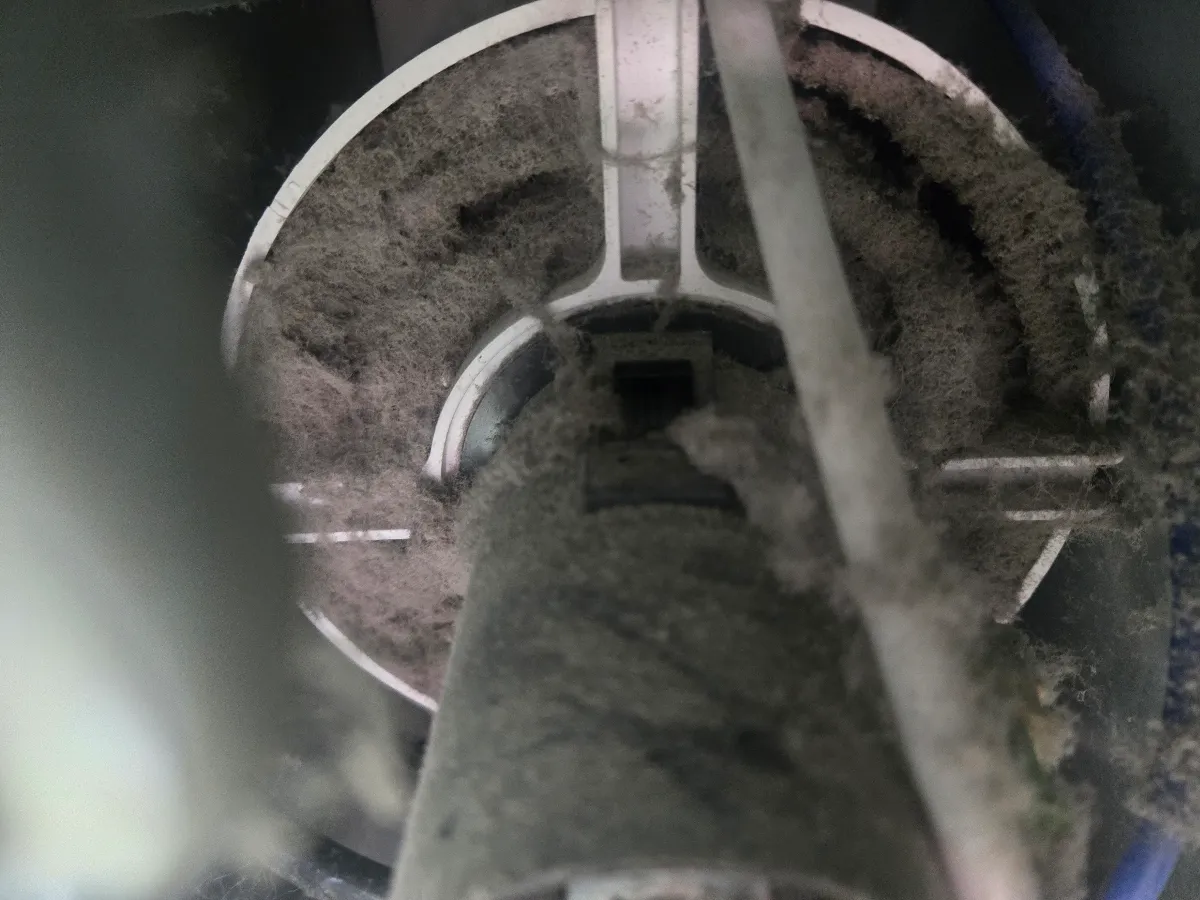
The photo is from that Gaggenau job: the freezer alarm kept going off and it was not freezing. You can read the full case in Gaggenau freezer alarm, not freezing: a clogged condenser.
What to check first
These checks are safe to do yourself and solve the simple cases:
- The temperature setting. Make sure the control has not been turned up or switched to a holiday or Sabbath mode. The Food Standards Agency advises keeping a fridge at 5°C or below; most freezers are set to about -18°C. After a change, give it 24 hours.
- The vents inside. Food pushed against the back wall or the air vents stops cold air from moving. Leave a gap and do not overfill the shelves.
- The door seal: the paper test. Close the door on a sheet of paper and pull it out. If it slides out with no grip, the seal is not sealing at that point. Check all four sides, and check the door closes on its own.
- Space around the fridge. A fridge needs air. Freestanding models need a gap at the back and top; built-in models need their front grille or kickplate clear. A grille covered by a cabinet door or plinth starves the condenser of air.
- The condenser grille. Unplug the fridge or switch it off at the isolator first. If the condenser or its grille is easy to reach, at the bottom front or the back, vacuum off the dust with a soft brush attachment. Do not take panels off beyond that.
Never open the sealed refrigerant system, pierce ice off the evaporator with a knife, or touch the mains wiring. Refrigerant work needs a qualified refrigeration engineer; ours are F-Gas registered. Regular cleaning is the best way to avoid most of the faults in this guide: see our fridge freezer maintenance tasks.
Fridge freezer not cooling but light is on
If the light is on, power is reaching the fridge, but the compressor is not running or the cold is not reaching the cabinet. Listen at the bottom or back: a fridge that is cooling makes a low hum and the condenser area feels warm. If it is silent and warm inside, the causes we find are:
- The compressor does not start. On a fridge freezer in an office in Central London that kept defrosting, the engineer found no response from the compressor; it did not start and had to be replaced.
- The board or inverter does not start it. On a built-in Gaggenau refrigerator that was not cooling, the condenser was completely blocked with dirt and had overheated. We replaced the control board and the evaporator fan, and when the compressor still would not start, a test inverter got it running.
- The compressor runs but the fan does not. On that same Gaggenau the evaporator was fully iced up and the evaporator fan motor was encased in ice and not turning, so no cold air reached the shelves.
If the display shows a code, look it up before you call: see our guides to Gaggenau fridge not cooling, beeping and error codes and Sub-Zero error codes.
Fridge not cooling but freezer works
This depends on how your fridge freezer is built. On many frost-free fridge freezers there is one cooling system: cold air from the freezer evaporator is blown into the fridge through a duct by a fan, and a damper or flap controls how much gets through. If the evaporator ices up because the defrost has failed, or the fan or damper stops, the freezer stays cold and the fridge warms up. A defrost repair or a new fan fixes it; defrosting the ice by hand only helps for a few days if the defrost fault is still there.
Premium built-in fridges such as Sub-Zero, Gaggenau and Liebherr often have a separate compressor and evaporator for the fridge and the freezer, so one section can fail on its own. Then the fridge’s own compressor, inverter, gas or evaporator is the cause. For Sub-Zero, our Sub-Zero fridge not cooling guide explains this in detail, including the case where a section has simply been switched off.
Freezer not freezing
A freezer that is cold but not freezing is usually struggling: a dusty condenser, a door that does not seal, or ice on the evaporator. A freezer that has gone warm usually has a part that has stopped. Cases from our records:
- A Viking fridge freezer that was not cold enough to freeze. The defrost control was not sending a signal to the defrost elements, although the elements themselves worked. On another Viking the minimum work was a deep clean of the condenser, a new defrost element and a new defrost terminator.
- A Sub-Zero freezer section that stopped working. The freezer compressor did not start in normal operation and had logged a long-run code. With a kick start it ran and passed a test, so the compressor drive (the inverter) and the compressor were the parts to replace.
- A Gaggenau freezer with the alarm on. A heavily dusty condenser had overheated the freezer, the fridge and the wine cooler on the same installation.
Fridge not cooling after power outage
After a power cut, first check the fuse, the breaker and the isolator switch, and check that the control has not reset to a different setting or a standby mode. Keep the doors shut and give the fridge time: a warm cabinet can take several hours to come down, and up to 24 hours to settle. Some brands have their own reset; for Sub-Zero it is described in our Sub-Zero fridge not cooling guide.
If it does not recover, the cause in our records is usually the control board or the inverter, which can fail when the power drops or comes back with a surge. On a Viking fridge freezer whose whole cooling system had stopped, the electrics had tripped; after a reset it worked for an hour and a half, then stopped again with the alarm on, which is the sign of a fault rather than the power cut itself. When we suspect a board, our engineer can fit a test board or test inverter on site to prove it before a new part is ordered.
Commercial fridge not cooling
More than 150 of our fridge and freezer requests came from restaurants, cafés, hotels and bakeries: undercounter and upright fridges by brands such as Foster, Polar, Gram and Williams, counter fridges and cold rooms. The causes are the same, but they come faster, because a commercial kitchen is hot and greasy. On a commercial Gram fridge the fridge was low on gas and the condenser was blocked; once it was cleaned and the gas topped up, the temperature came down, and it also needed a new controller and a freezer door seal. A set of Foster fridges needed new fan motors and a compressor. In a bakery’s walk-in cold room only one of the two evaporators was working. See our commercial refrigeration repair page.

When to call an engineer
Call an engineer if the fridge is still above 5°C or the freezer is not freezing 24 hours after the checks above, if the light is on but the compressor is silent, if one section is warm and the other is fine, if you see thick ice on the back wall, or if a code or alarm keeps coming back. Move food that must stay cold, and keep the doors shut. If the fridge freezer is also tripping the electrics, tell us when you book: on a Sub-Zero drawer unit the cause was the defrost heaters tripping the breaker.
We repair fridge freezers of all brands, and have brand pages for Sub-Zero, Gaggenau fridges, Liebherr, Miele, Fisher & Paykel, Viking fridges, Smeg fridges and Siemens fridges. For a fridge without a freezer, see our fridge repair service in London.
Fridge freezer repair in London
LE Company’s call-out is from £175 + VAT and includes the first 30 minutes on site, when the engineer finds the cause of the fault. The cost of the repair is agreed with you before any work starts. 12-month guarantee on parts — we fit only original manufacturer parts. Call +44 203 603 7172.
The visit with the assessment is paid first. Our engineers are Gas Safe and F-Gas registered, so leak repairs and regassing are done by us on site. We work Monday to Saturday, 8am to 8pm; Sunday visits are for service-contract customers only. See our fridge freezer repair page, our full appliance repair in London, or read our frequently asked questions.